

The West Cork Mines: Part One, the Cornish in the Sheep’s Head Peninsula
© Dr Sharron P. Schwartz
Not to be reproduced without permission
Taking advantage of a good weather window during what has been a particularly cold and wet spring, we packed up our Land Rover camper and headed to West Cork for a mining expedition. All of the mines in the three peninsulas (Beara, Sheep’s Head and Mizen) that jut out into the Atlantic Ocean like the fingers of an outstretched hand, were managed or promoted by Cornishmen.
Only rivalled by County Wicklow in terms of the importance of its metalliferous mines, at its zenith in the mid-nineteenth century, West Cork sustained a mining workforce of some 1,200-1,500 people. This region of Ireland contains some superlative industrial archaeology in the shape of several Cornish-type engine houses (including the best-preserved example of a purpose-built man engine house in the world) and a remarkable density of mid-nineteenth century circular powder houses, which are extremely rare worldwide.
After a long drive south, we arrived at our first wild camping spot on the cliffs above Bantry Bay on the northern side of the Sheep’s Head Peninsula, where the only sound was the roiling Atlantic and the croaking of a cock pheasant in the nearby scrubland. We were treated to a spectacular sunset and a magnificent starry sky, a reminder that much of this part of County Cork is included in a night sky reserve.
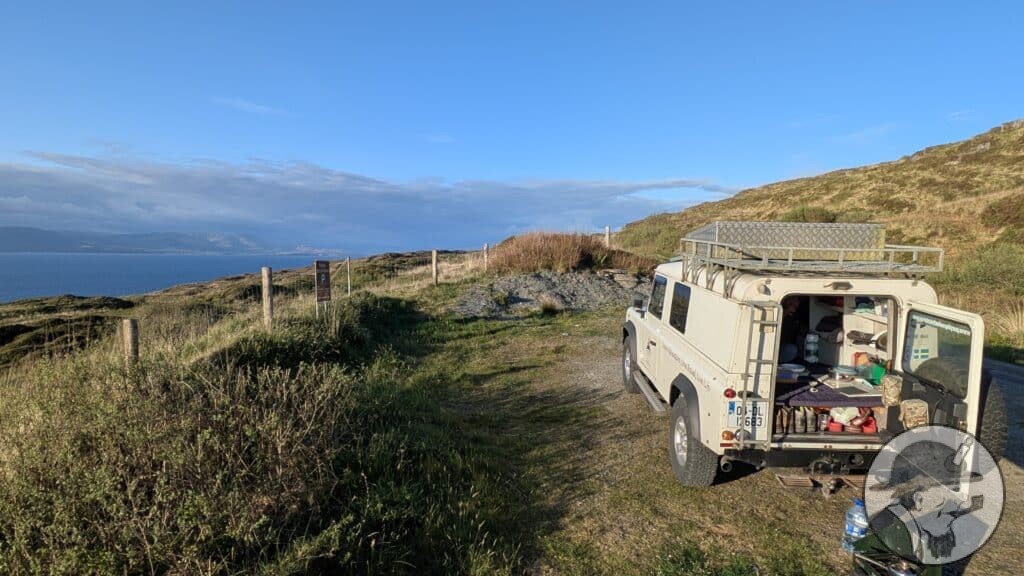
The following morning was a little bleary, with an angry bank of grey cloud threatening rain from the west. But the sun soon broke through the gloom as we parked above the slipway at Evanson’s Cove to begin our exploration of the Cornish in the Sheep’s Head Peninsula. We headed over a stile on the Sheep’s Head Way towards Gortavallig Mine (also spelled Gurtavallig).
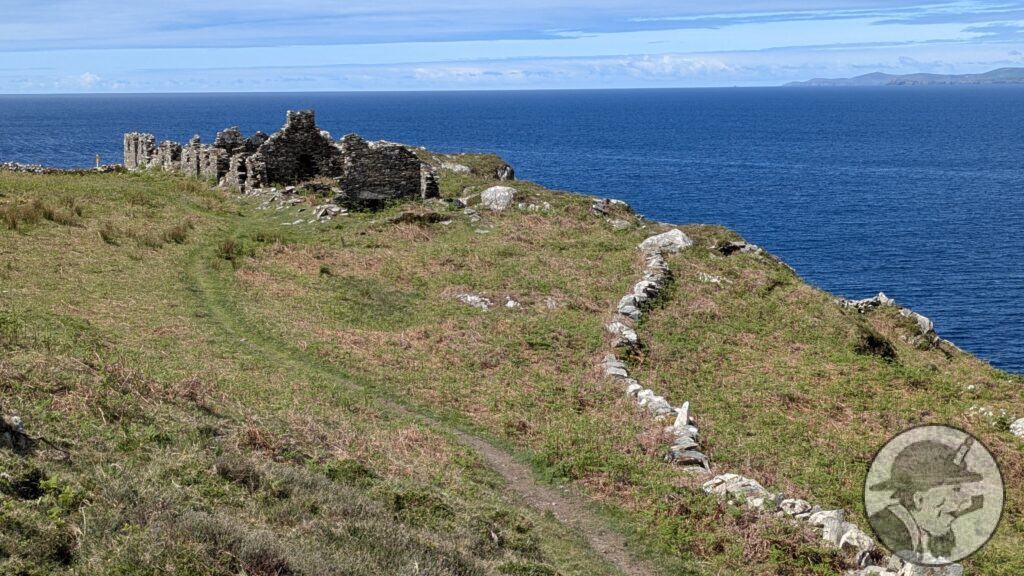
After a 20-minute moderate hike across sheep-grazed land (no dogs allowed) notable for its undulating ribs of rock, we crested the top of a ridge. Below we spied the gaunt shells of a row of miners’ cottages built atop the cliff edge to house the mineworkers, some of whom came from Cornwall.
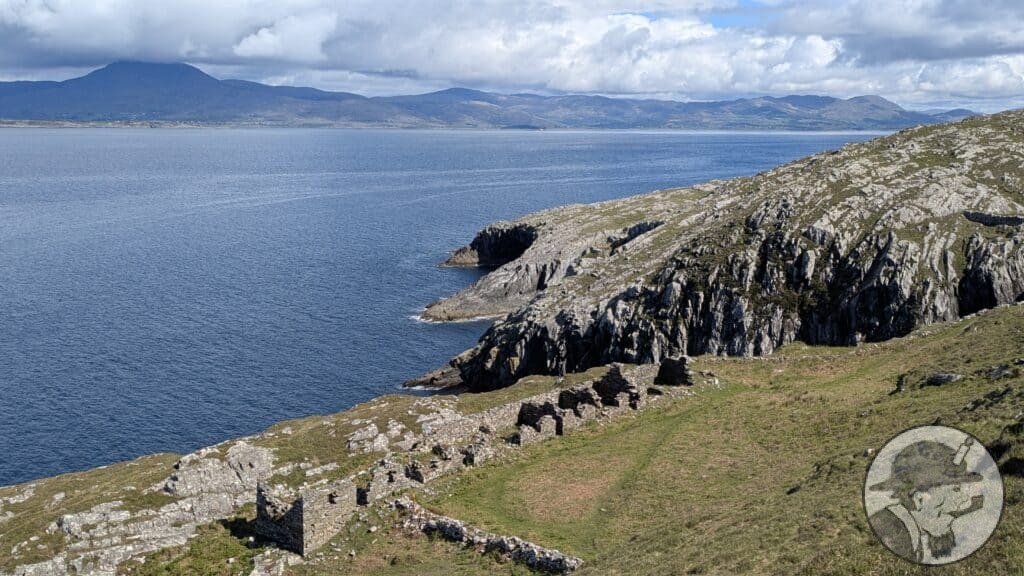
This copper mine is remote now and would have been more so the mid-1840s, when it was described as being in one of the wildest districts of the United Kingdom. In 1841, J.D. Crocker and a ‘scientific gentleman’ from Cornwall found symptoms of mineral wealth at Gortavallig, but to develop the mine would have caused the outlay of several thousands pounds, so it was let to lie idle for the next four years.
With the coming of railways in the region, the mine was promoted by Cork speculator, William Connell, who believed this part of Cork to be the ‘Cornwall of Ireland’. It was subsequently developed by the newly-formed Southern and Western Mining Company of Ireland (with several mines elsewhere), that talked the prospect up by quoting its proximity to the famous Berehaven Mines at Allihies (see following post).
I last visited Gortavallig in the summer of 2005, when thigh-high bracken obscured much of the industrial archaeology, so a visit in spring, when the bracken has hardly begun to grow, is a far better time to see things on the ground.
We counted 10 single-storey cottages which were constructed of stone with slated roofs. The windows faced landward, for although the views over Bantry Bay towards Bear Island and Hungry Hill are both stunning and dramatic, the prevailing wind blows from the southwest, bringing severe storms and furious winters.
Each cottage had a fireplace; much needed in the cool, damp, maritime climate. When warmed by a peat fire, the cottages would have been quite cosy, which was just as well, as the occupants had to pay rent. A nearby well, now choked with vegetation and difficult to spot, provided fresh drinking water.
The mine was directed by Captain William Thomas (1807-1890) who was also Connell’s manager at Coosheen Mine (see part three of this blog series), having arrived in Ireland from Cornwall in 1841. The resident mine agent was Captain James Bennett (who had possibly worked in the Valley Section of Dolcoath Mine with William Thomas’s father in the 1820s, and who had the nickname of Patience). Both men hailed from the mining hamlet of Bolenowe near Camborne, and might even have been related.
William was one of three Thomas brothers, the sons of Captain James ‘Jemmy’ Thomas (of Dolcoath Mine) and Jane Penpraze, who left Cornwall for the mines of West Cork (the other two being Charles and Henry). Members of this core Camborne family, a dynasty that became synonymous with Dolcoath, later took ship for Mexico, to work in the Real del Monte and Pachuca silver mines.
Many of the mines of West Cork had highly discrete migration flows from certain parishes of Cornwall, even down to the level of hamlets such as Bolenowe, due to the movement of people closely united by ties of kinship, place of employment and even religion (Methodism).
William Thomas laid out the line of a new road to serve the mine, ending at Evanson’s Cove where Captain Bennett’s house was located above the old cobbled slipway, which was covered with a glorious display of sea pinks during our visit.
“A newly formed and verv remarkable road passes across the rocky peninsula of Mintervara to the mine. This latter road, about two miles in length, deserves notice, as well from the ingenuity of its construction over very difficult country; as from the small cost at which it was made – namely, £97 10s – or about 4s, per perch.” Cork Examiner, August 1847
The men, 41 in number, were employed for 11 weeks and paid in food rather than money. The road was constructed by voluntary subscriptions and was superintended by Captain Bennett. Previous to the road’s construction, no wheeled vehicle could get to Evanson’s Cove from whence the remote mine was reached:
“A complete wilderness and barren cliff, which had been for past ages the undisturbed resort of the Eagle, the Hawk, and Wild Sea Bird.”
Captain William Thomas’s 1847 description of Gortavallig copper mine.
By dint of hard labour, within 16 months the site was transformed into a valley of native industry, giving employment to around 50 people, including men working underground and local women and children dressing the ores at grass.
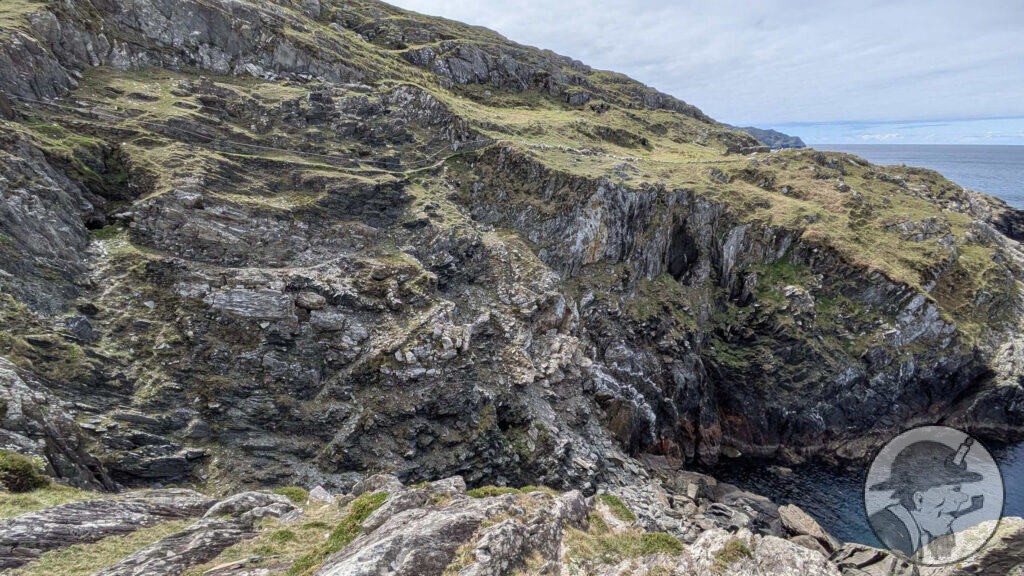
Adits were driven in from the cliff to intersect three very large ‘champion lodes’, and a dressing floor, fed by a small reservoir perched on the cliff top, was laid out at the base of the cliffs to receive the ore trammed from the workings. A narrow miners’ pathway, precariously cut into the cliff face, led from the miners’ cottages towards the reservoir and now forms a dramatic section of the Sheep’s Head Way.
A zig-zag pathway, reminiscent of that at Botallack Mine in Cornwall, led down to the dressing floor, adits and two substantial quays constructed of stone, which enabled the ore to be shipped. Even when the mine was working, the descent of this pathway was an ordeal unlikely to be forgotten in a hurry!
“The face of the cliff appeared at first sight quite precipitous, but closer inspection shows a devious path of doubtful safety leading in a tortuous course to the adits and dressing floors. Descending by this pathway – an operation by no means easy to a citizen – the daring character of the undertaking becomes conspicuous, and it was evident that whole masses of rock must have been thrown into the bay to form the platform on which the dressers were occupied.” Cork Examiner, August 1847
The mine was not a success due, it is claimed, to the heavy financial burden the company incurred to secure a Royal Charter of Incorporation to work mines in Cork and other counties, combined with the devastation of the 1846 famine, which led to the collapse of the Southern and Western Mining Company of Ireland and the abandonment of the works in 1849.
The only documented ore that was shipped amounted to 88 tons, sold at Swansea in 1848 for a little over £269.
In 1862, the Carbery Mining Company Ltd proposed to raise a capital of £5,000 in 5,000 shares of £1 each to purchase the Gortavallig Mine. The proposed manager at this time was another Cornishman named Captain John Penrose. The only known plan of the workings – a horizontal one – was drawn in 1863, presumably to attract investors. However, Gortavallig did not reopen.
The cliff face zig-zag miners’ footpaths are extant, but the dressing floor and quays have been lost to the Atlantic.
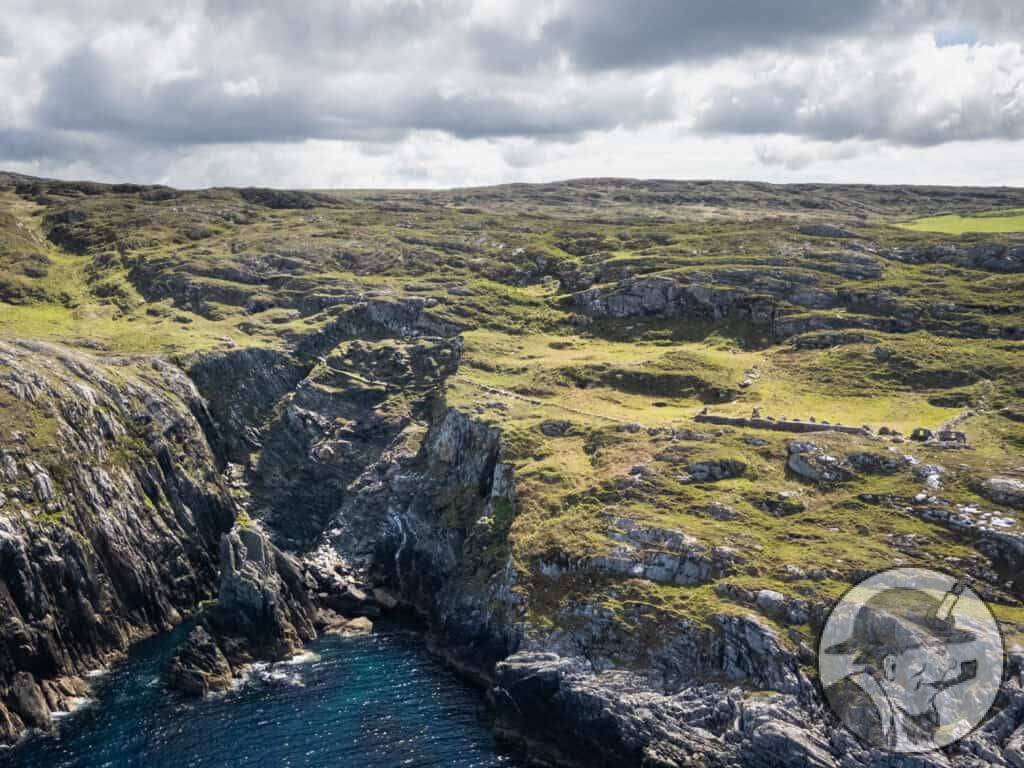
The smithy and a carpenter’s shop mentioned by Captain Thomas were probably sited close to the dressing floor and have have long since vanished. There is no sign of a powder house, which is surprising given the frequency with which they have survived on other West Cork mines. A fenced shaft may be seen to the east of the miners’ cottages.
The best-preserved remains are the ten cottages and the lily-covered reservoir, complete with sluice gate, set into a well-crafted revetment wall.
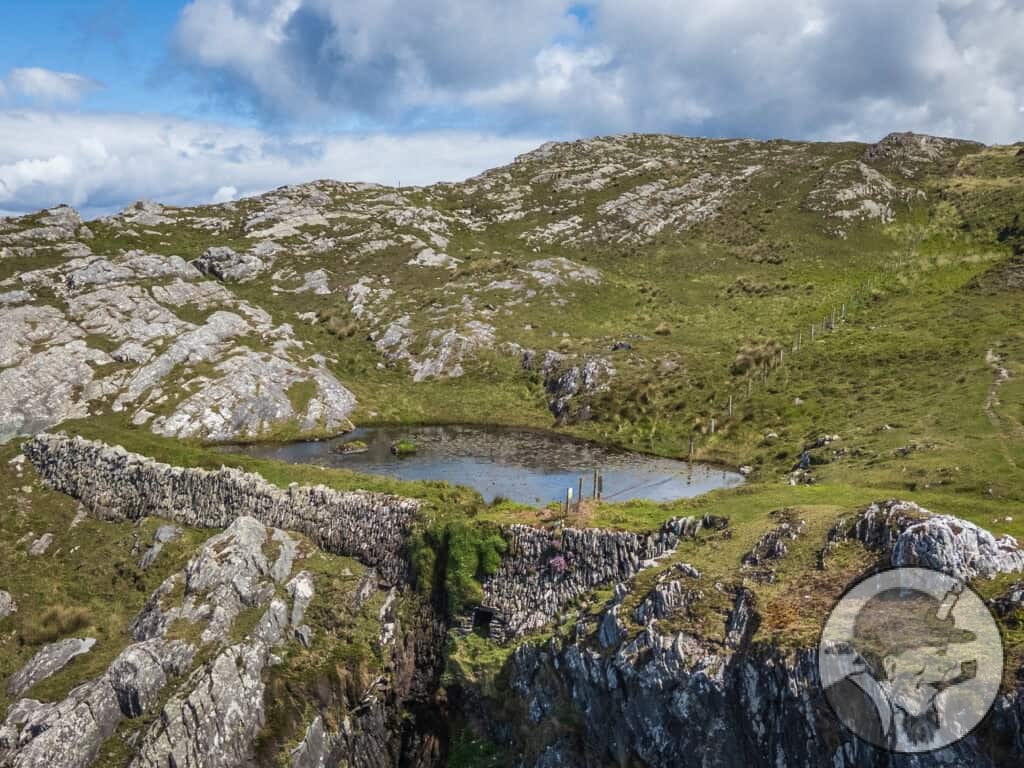
Access into the underground workings, some of which display excellent secondary copper mineralisation, requires abseiling down the cliff face to gain entry into the adits. Dr Martin Critchley and others entered the underground workings to survey them in 2005.
Just over 3km further east we came upon Killeen Mine, which I last visited in 2006. This mine was also worked for copper.
Parking is difficult as the road is narrow. The mine is accessed via a locked gate and, at the time of our visit, was already becoming choked with freshly growing bracken.
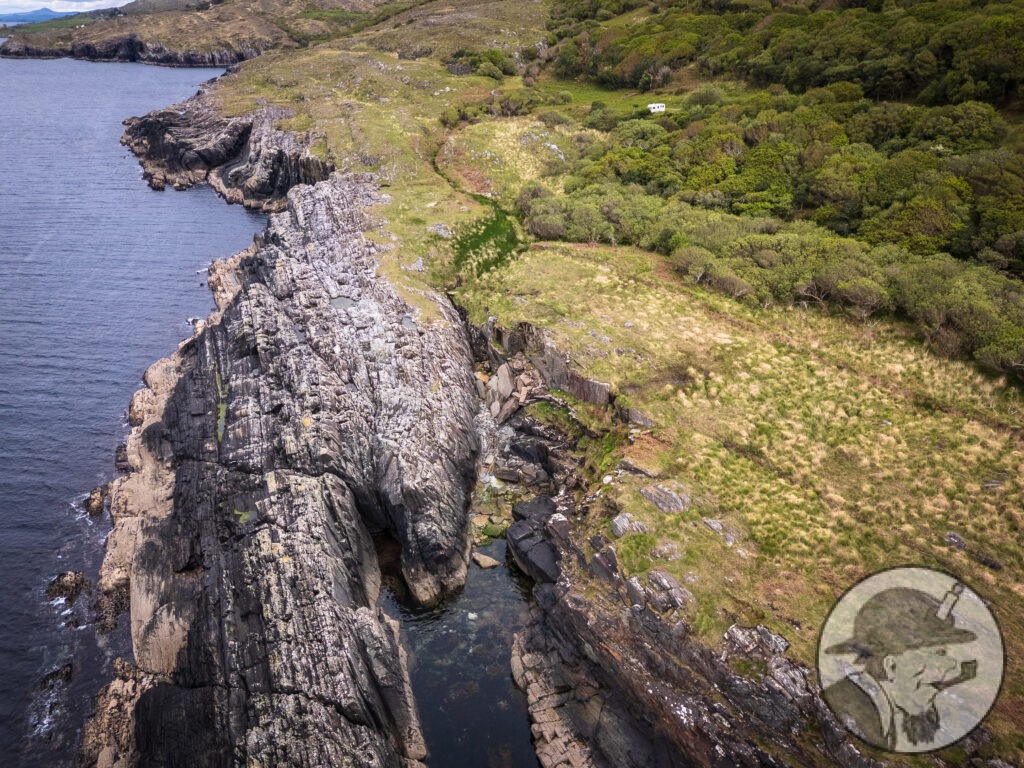
In 1845, it was noted that the mine was being worked by three private individuals. Following the stoppage of Gortavallig, Captain William Thomas suggested to William Connell that an independent company be formed to work Killeen, which he considered to be a most promising prospect.
Connell was persuaded, and along with Captain Thomas, a private company was formed with the final partner being one of the Carmichael family of Cork City (possibly John Carmichael, cloth and woollen merchant). The three partners held similar amounts of shares, and a small number were also given to Captain James Bennett who had been the resident agent at Gortavallig, who agreed to manage Killeen Mine.
By 1849 a shaft had been sunk and an adit driven from the cliff to meet the shaft. However, following the collapse of the Southern and Western Mining Company and Thomas not receiving his salary at Coosheen as a result, he was unable to meet his one third share of the expenditure in the venture which now threatened to sink the mine. Consequently, the partners settled all accounts between them and ceased operations.
William Thomas, who had been sent to Connell’s mine in Kenmare, County Kerry, still had faith in the venture, for he wrote to William Connell in May 1849 reflecting on the potential of Killeen.
“In all the mine I have ever seen I have encountered nothing like the extraordinary character of the lodes and intentions at Killeen.”
Captain William Thomas, 1849.
Thomas persuaded his partners to give him £5 apiece to go to London to raise capital for the venture, which accordingly happened.
He claimed to have sold the mine to an English company for £300 with the aid of Seymour Smith who inspected the mine (and a neighbouring one, probably Glenaulin and/or Carravilleen) prior to its purchase and consequent sale.
However, the sale was mired in controversy which landed Thomas in court at Cork, where he was accused by William Connell of attempting to defraud him of £100.
“Those Cornish miners are terrible fellows.”
Legal counsel for plaintiff, William Connell, 1852
Thomas lost the case and was ordered to pay Connell over £65 plus costs, which drew the ire of the Mining Journal, which defended Captain Thomas in a somewhat cryptic article:
“It is, we think, needless to comment on what we cannot designate by a milder term than a vile scheme between a “Cork broker” and a “London quaker” to injure the reputation of an honest man—a man, by the way, who has done, and is still doing, more good for the mining interests of the south of Ireland than any other person who has come into it. We shall have our eye upon the pair alluded to.”
Mining Journal, May 1852
Indeed, this accusation seems to be something of an unlikely stain on the character of a man much respected in West Cork for his unstinting efforts to alleviate the suffering of the poor during An Gorta Mór (the Great Hunger/Famine), even to the extent of advancing his own capital in the establishment of a fishery at Coosheen (Cork Examiner, 20 August 1847).
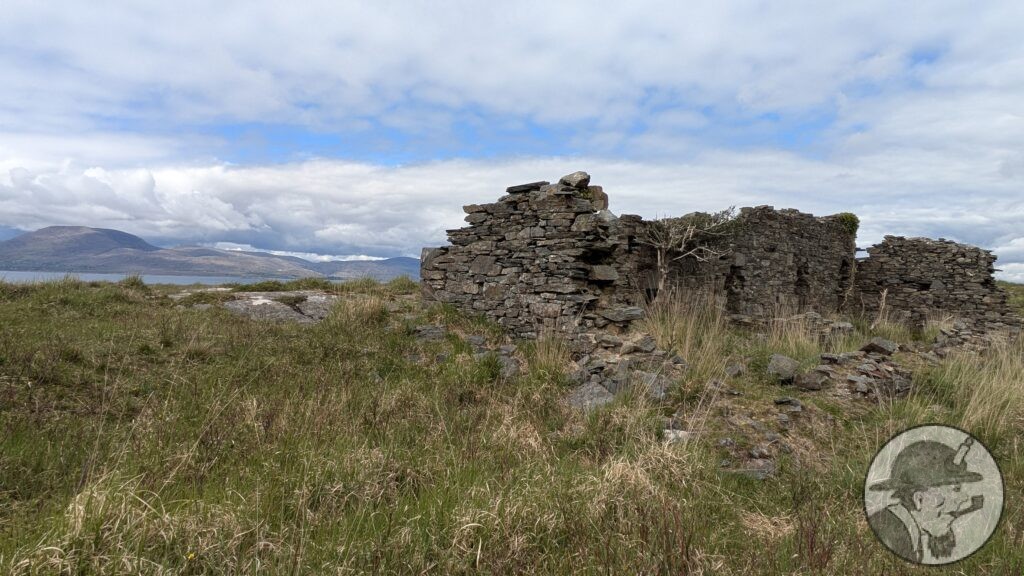
At the beginning of 1853, the Mining Journal stated that the copper mines of Killeen, Glenaulin and Carravilleen had recently been taken up by a company and were being worked with spirit.
However, it seems the company’s operations were short-lived, for by 1862 it was reported that the mine was about to be inspected by another company.
Killeen had allegedly produced hundreds of tons of mundic and several tons of copper ore. As Mundic Shaft (Cornish dialect for iron pyrites, or fool’s gold) was being sunk, a cavern was found in the lode which would contain six or eight men, the sides of which consisted of mundic and copper ore, and coated over with black oxide of copper.
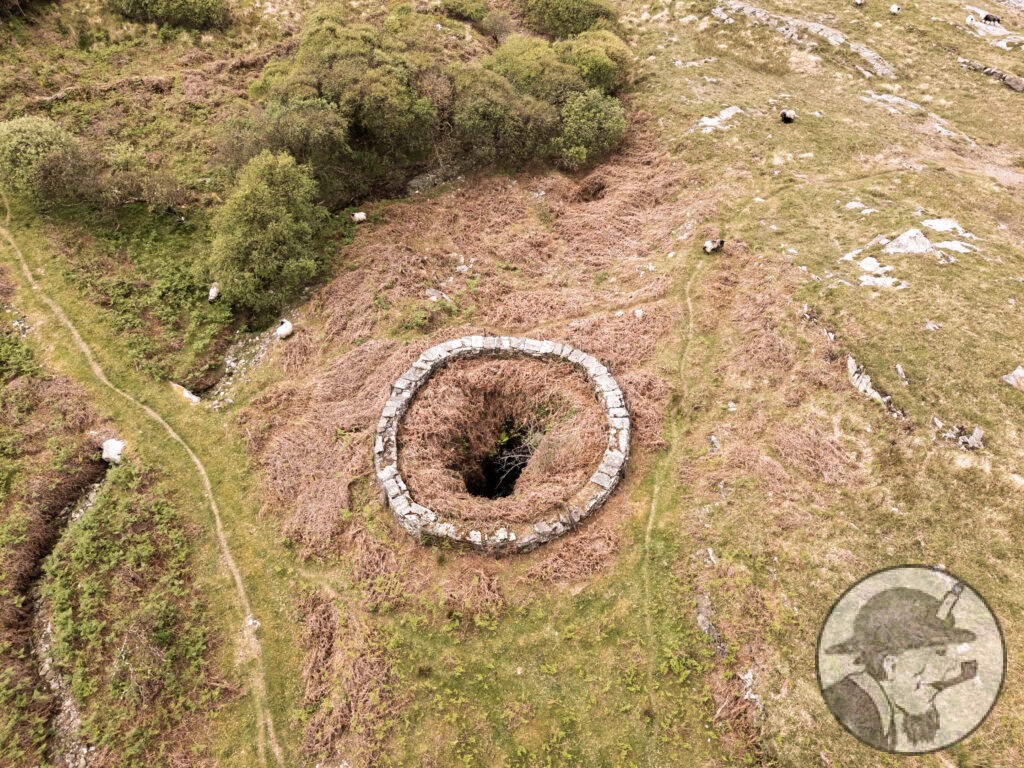
The Killeen Mining Company reopened the mine without success for it was idle again by the summer of 1864.
Captain William Thomas pops up again in relation to this mine, for he was involved in The South Berehaven Mining Company, a London-based venture with a capital of £25,000 of 2,500 shares of £10, formed in 1884. The mining captain was a Cornishman named Rowe and the mine reportedly employed 50-60 men.
This company was no more successful than its predecessors and the company was voluntarily wound up at the beginning of 1886. It sold just 47 tons of ore in 1884 and 127 tons in 1885, which coincided with a slump in the price of copper ore.
It appears some mining continued there into the 1890s, for Killeen appeared in the Mineral Statistics with other William Thomas ventures, including Coosheen. His death in 1890 probably put paid to any further attempts to revive the mine.
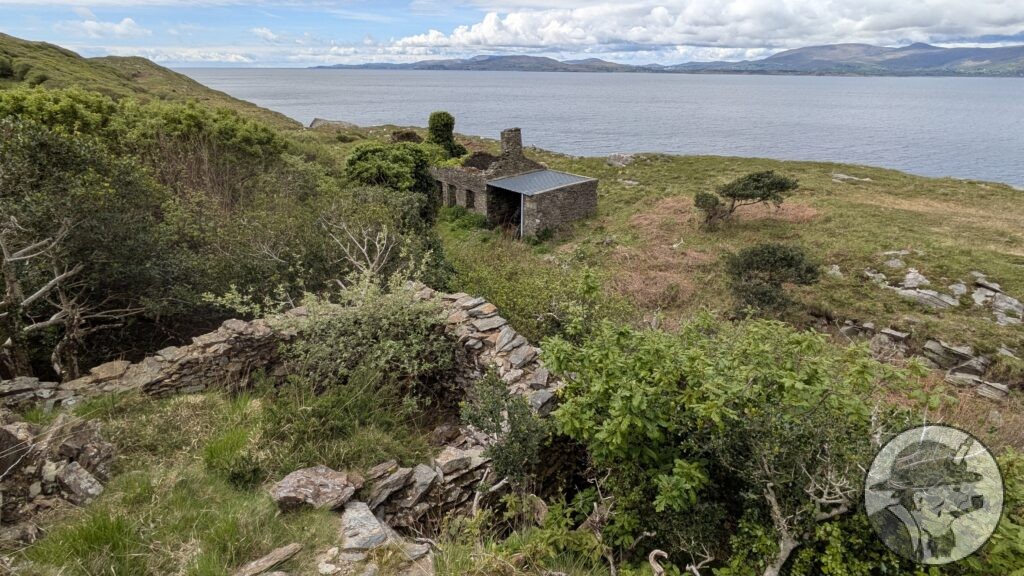
A masonry casement for an overshot waterwheel is sited in front of the westerly and more substantial of two rows of buildings. The water was brought from the nearby stream via a wooden launder. The casement is far more vegetated with ivy than it was in 2006.
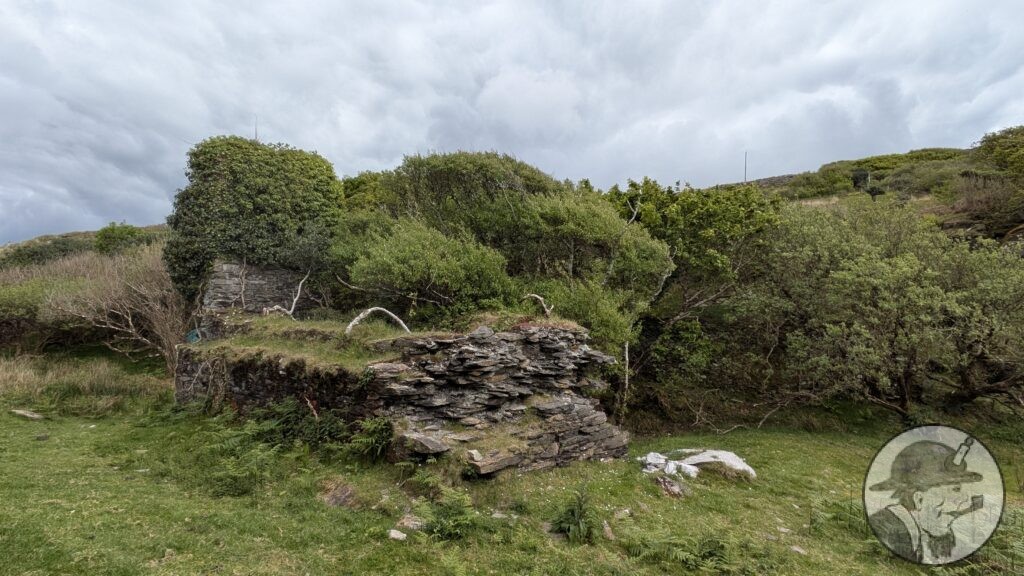
Local lore states that this wheel powered a crusher, but there is no sign of any suitable building in its immediate vicinity. The water that had passed over the wheel would have been conducted onto dressing floors sited between it and Mundic Shaft. The copper mineral was undoubtedly dressed by hand and riddled in wire sieves.
Rather, the waterwheel seems to have powered pump rods in the Mundic Shaft, for we spotted a probable flatrod stanchion midway between the waterwheel and the collared shaft.
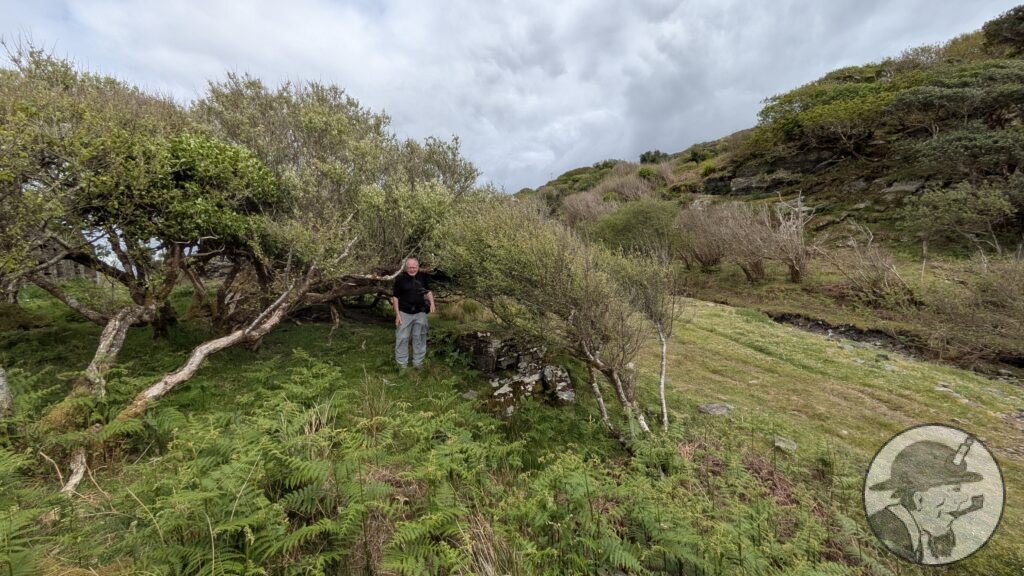
The row of four cottages near the waterwheel casement contain fireplaces and look to be more recent than the earlier row sited to the east, the walling of which is far more eroded.
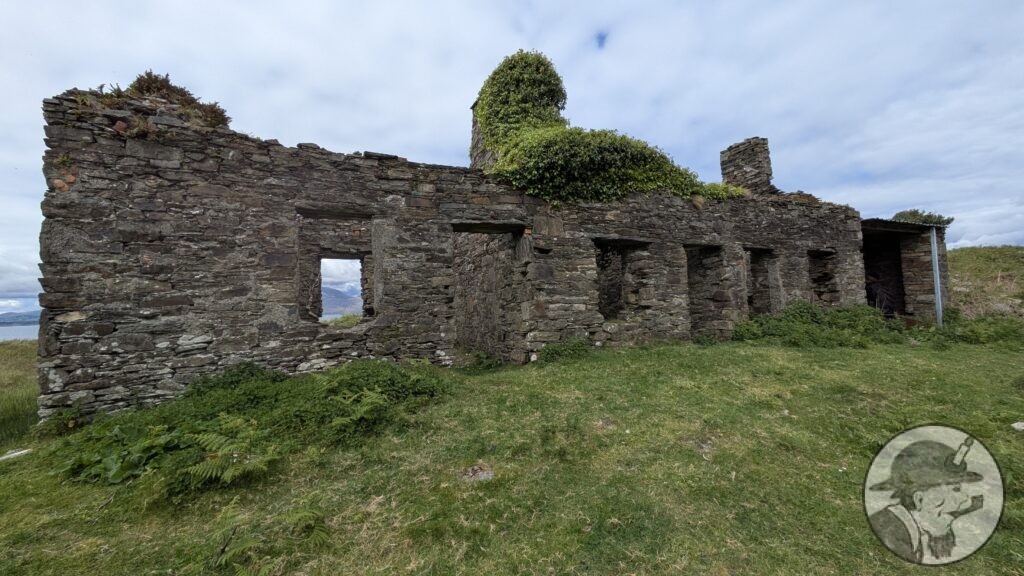
Since my visit in May 2006, the most easterly cottage in the newer row has had its gable end chimney removed and has been roofed with tin sheeting to house agricultural machinery.
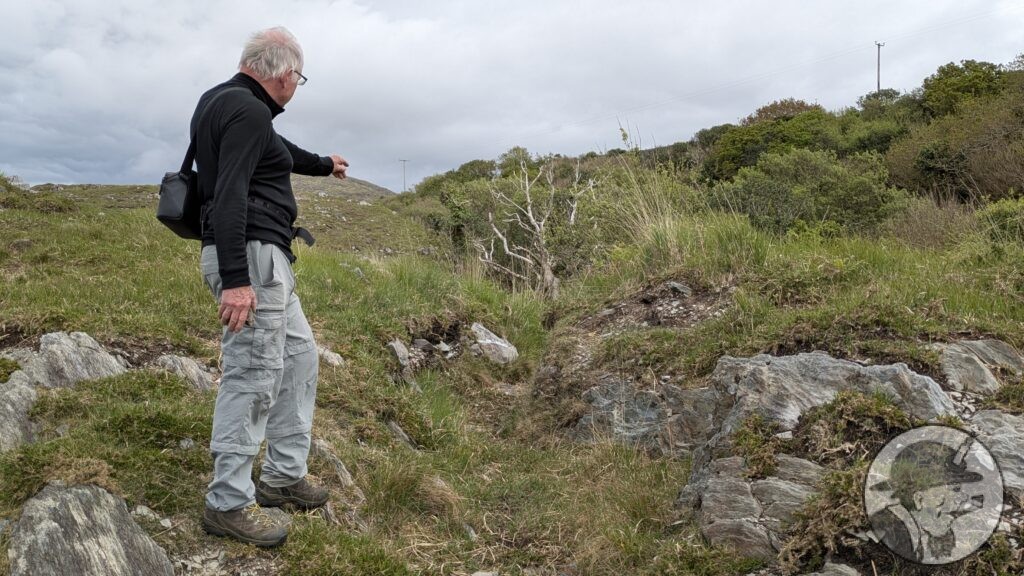
Various smaller and older buildings in various states of dilapidation can be seen on a platform built into the slope of the hill.
We did not clamber down the cliffs to inspect the adit, which is still open.
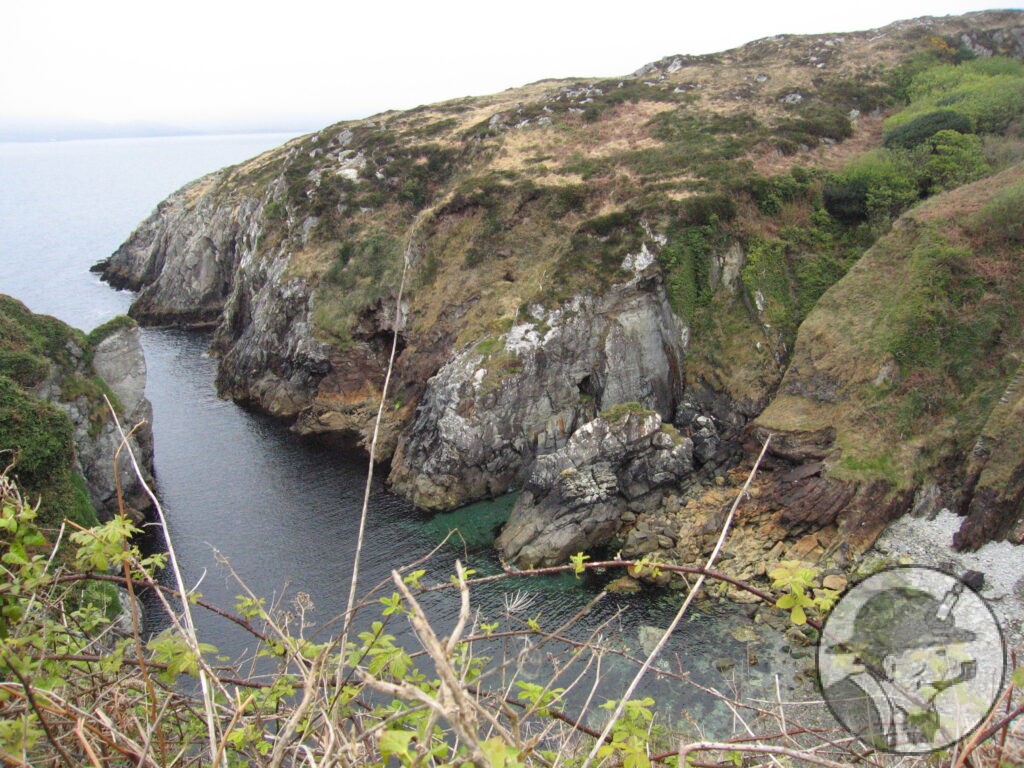
Travelling eastwards along the coast, we soon came to the mines of Glenaulin (Glanalin) and Carravilleen tucked away on either side of a narrow inlet named Glanalincoosh which contains a pretty waterfall. Glenaulin is on the western side and Carravilleen on the east. These mines are also intimately associated with the Thomas’s of Bolenowe.
Parking is extremely awkward as the road is very narrow.
Trials on eight lodes (including one over 3 metres wide) had been undertaken by Captain William Thomas, and two of them were intersected by an adit. Several tons of rich copper ore were raised and sold before the collapse of the Southern and Western Mining Company of Ireland stopped work.
In 1852, the Glenaulin and Carivilleen Mining Company, a concern in 24,000 shares of 10s each, was set up with Captain William Thomas of the Kenmare Mines as manager. One of the Directors was the Reverend George Bull, Vicar of Treslothan Church, not far from Bolenowe, the Thomas’s homeplace.
In addition to the copper lodes of ‘masterly character’, an immense deposit of carbonate of manganese was discovered, which was used extensively in Ireland for bleaching and other purposes:
“Thousands of tons -in fact an unlimited supply [of manganese] – can be raised and shipped at 10s. per ton, the average price of this commodity being £3; this would, therefore, of itself produce a revenue of no ordinary kind to the shareholders.” Company prospectus, Mining Journal, April 1852
The mines could be worked by adit, hence no machinery was required. Dressing floors and quays to export the ore had been constructed and prospective shareholders were assured that work was in full swing, yet terms for the setts had not yet been finalised with the proprietors. Ominously, in July 1852, the Mining Journal listed both mines as not having sold shares. Disaster struck when the quays were swept away in a violent storm at the beginning of 1853.
By the summer of that year, a new mine captain had been installed: John Thomas, the 24-year-old son of William Thomas, baptised at Camborne in October 1826. He had cut his teeth in the mining industry at Coosheen copper mine where he was living.
Young Thomas talked up the mines in his first report, stating that their prospects were greatly improved and he expected to be shipping ore by the end of June 1853.
However, in September 1853, an anonymous London shareholder expressed his disquiet that one so young “who cannot be supposed to know anything about it” and who moreover resided some 30 miles distant, should be entrusted to manage operations at the mines.
Yet another anonymous letter written by someone from Skibbereen appeared the following month:
“A ‘young gentleman’ from London, fresh from the City, is sent over, and had the whole and sole management of the mine, at surface and underground. He, of course, lives on the mine? No such thing, but patronises all the balls, routes, picnics, etc., in the country, quarrels about young ladies, and gets horsewhipped in our streets.”
Mining Journal, October 1853.
The Thomas’s appear to have made enemies in Cork, for it is doubtful there was any truth in the above description of Captain John Thomas, who married Helena Triphook, a relative of the Reverend John Triphook, the Rector of Schull, in October 1853.
It is possible that the vituperative publicity was instigated by another Cornishman, William Tonkin of St Agnes, a member of another important Cornish mining dynasty involved in West Cork mining (see part three of this blog series).
Tonkin had arrived in Ireland in about 1832 and had worked at Coosheen as an ore dresser, until he was relieved of his post for incompetence by Captain William Thomas. This appeared to have been the start of a long running feud between him and the Thomas clan.
Tonkin was involved a court case heard at Bantry towards the end of 1854, claiming £8 for services rendered as surface agent and ore dresser at Glenaulin, which he won and was awarded £6.
Shortly afterwards, he crossed swords with Captain Charles Thomas, John’s uncle at Dhurhode Mine. This unedifying dispute ended up in court, resulting in Charles Thomas’s dismissal from Dhurode Mine, and his replacement by the victorious Captain Tonkin in 1855.
However, accusations in 1855 that the Glenaulin and Carivilleen Mining Company had never audited its accounts, led to the pursers, Sutton and Swahy, being taken to the Court of the Queen’s Bench in the spring of 1856 by the Company’s solicitors, Tyrell and associates.
On being awarded a judgement of £97, Tyrell called at Cannon Street, the company’s registered London address, to collect the money, only to find that the pursers had absconded, having sold their furniture to pay the rent.
The mines were idle in 1860, but they were reworked to a limited extent by the Glenaulin Company between 1862-65.
It was reported that the mines had recently reopened in 1884, were not employing many men, the lodes had not been opened up to any great extent, but houses had been constructed for the workmen. It seems this was the final working of the mines.
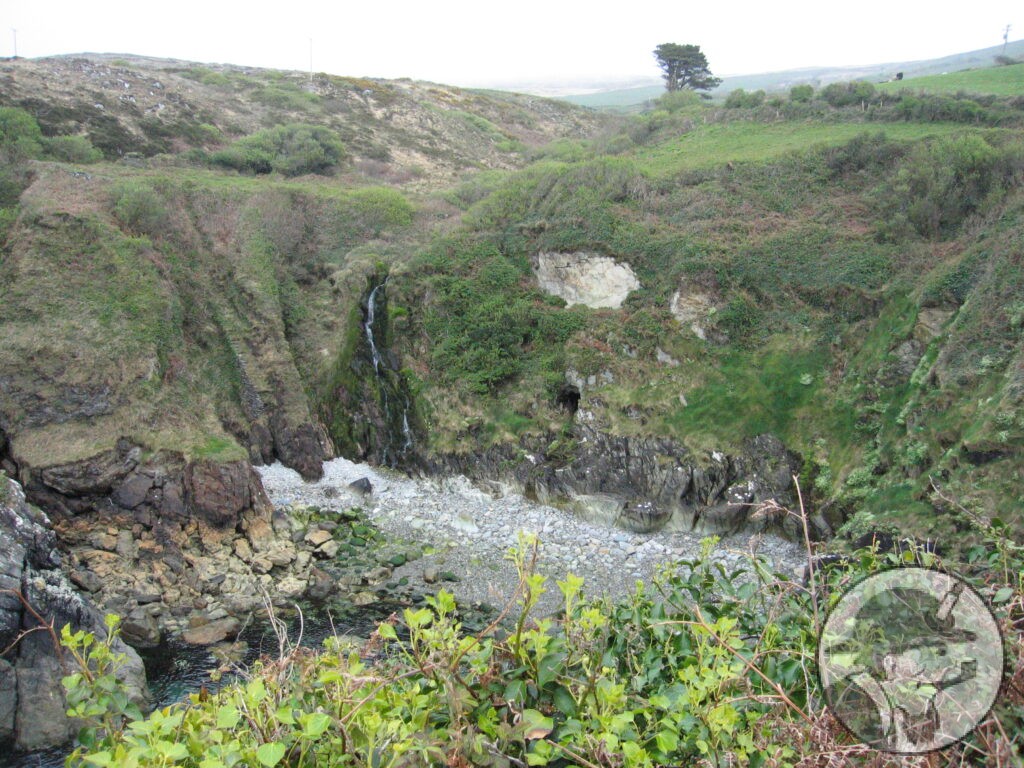
A row of miners’ cottages are all that remain on the surface of the mine. A set of stone steps lead down the cliff face towards the cove where the dressing floors and quays were sited.
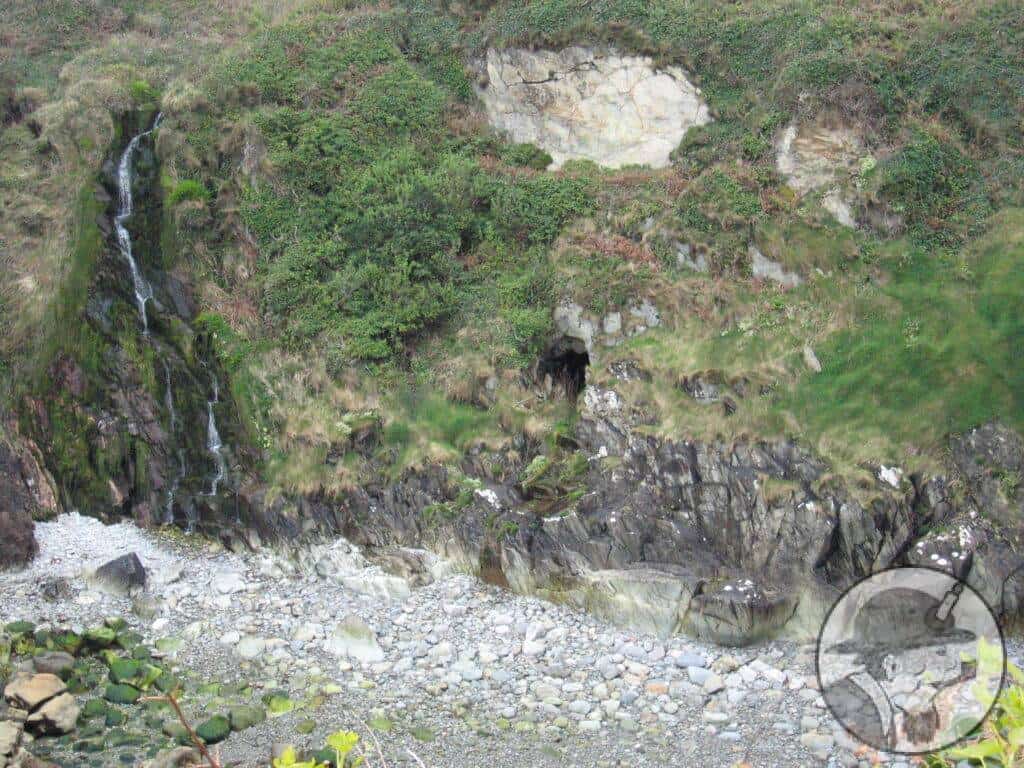
Two adits can be seen, one on the east side of the cove, another on the southern side which runs inland for some distance. The east adit is the more interesting of the two, leading into workings. We did not enter the adit during this visit.
We did not visit the Rooska Mine on this trip, having inspected it in 2006, and found no surface remains.
This silver-lead mine, sited just over 7km SW of Bantry, was noted as working in 1841 by Frederick Roper who was inspecting mines for the Children’s Employment Commission. It was employing just 20 men who were engaged about shaft sinking.
In 1849, the mineral rights were bought by Captain Henry Thomas (1811-1873). The mine was sold in 1854 under the Encumbered Estates Act. A steam engine, imported to Bantry, was sold in 1857 after an official of the company absconded with the majority of the company’s capital. No obvious trace of its house remains at the surface.
In 1864, it was being worked by Captain Charles Thomas and another Cornishman named Captain Mitchell. The mine was abandoned, allegedly over problems with the lease.
After tracing the Cornish in the Sheep’s Head Peninsula, it was then time to head to Bantry and on the Beara Peninsula, to the Puxley’s Allihies Mines, made famous by Daphne du Maurier in her novel, Hungry Hill. These will be described in the next blog in this series.
The West Cork Mines and their Cornish Connections: Part One, the Sheep’s Head Peninsula
Dr Sharron Schwartz
Specialist in Cornish mining migration and transnational communities