
The Making of ‘Cousin Jack’ and ‘Cousin Jenny’
Unless otherwise stated, all content is © Sharron P. Schwartz and may not be reproduced without permission
The Making of ‘Cousin Jack’ and ‘Cousin Jenny’
A Working Paper
Copyright © Dr Sharron P. Schwartz 2023
That the Cornish are closely associated with hard rock mining is well known, epitomised by the saying, ‘where ever there’s a hole in the ground, there’ll be a Cornishman working away at the bottom of it.’[1] Cornwall is a peninsula at the far south west of Britain that covers an area less than 3,562 km2 (1,365 square miles), and at no time during the nineteenth century had a population greater than 375,000.[2] Yet Cornwall’s size, both in terms of territory and population, is disproportionate to the impact the Cornish have made on the global hard-rock mining industry in the century after 1815.[3]
Cornwall was undoubtedly one of the great emigration regions of Europe.[4] In the last quarter of the nineteenth century alone, a figure equivalent to 40 per cent of Cornwall’s young adult males and 25 per cent of its young adult females migrated overseas.[5] During the 1860s and 1870s, Cornwall was the only English region where there were more overseas emigrants than migrants to other parts of the UK. Dudley Baines estimates that gross emigration would have been about 20 per cent of the Cornish-born population in each ten-year period from 1861 to 1900 and about 10 percent of the female.[6] Many of the male migrants were connected to the mining industry in some way. They have been dubbed ‘the aristocracy of mine labour’[7] or ‘the light infantry of British capital,’[8] and were nicknamed ‘Cousin Jacks.’ Yet, as Cornish historian John Rowe has noted, although ‘Cousin Jack’ is a widely used nickname for a Cornish miner, no one is really sure how it came about.[9]
The Origin of the Nickname ‘Cousin Jack’
The nickname was certainly well-established by the turn of the twentieth century, as illustrated by a Scottish newspaper which in 1906 stated that the Cornish miner who had migrated the world round was known as ‘Cousin Jacky’.[10] And American folklorist, Wayland D. Hand, had this to say in 1946:
‘It is difficult to overestimate the contribution of the Cornish miner to the development of hard rock mining in the United States, but great as had been this contribution, it has scarcely exceeded the rich legacy of mining lore and legend, the delightful humour and colorful speech and the customs and traditions that are part and parcel of the Cousin Jack everywhere in his adopted homeland’.[11]
The nickname allegedly arose because the Cornish were renowned for being exceptionally ‘clannish.’ Indeed, as early as 1825 a British mining director in Chile remarked that, ‘they harmonise together, One and All, but not with strangers.’[12] Therefore, Cornishmen always seemed to have a Cousin ‘Jack(y)’ at home who needed a job,[13] which led to them monopolising mine labour, in turn giving rise to what’s been dubbed the ‘Cousin Jack network’ which rubbed mineworkers from other countries up the wrong way on numerous mining frontiers.[14]
This feeling was well-articulated in 1901 by Irishman, John Michael Finnerty, the Warden of Kalgoorlie in Western Australia, who recalled what he discovered when he arrived there in 1889:
‘In the early days of the fields nearly every mining manager was a Cornishman, and a Cornish miner coming from anywhere was almost sure of getting a job on a mine that had a Cornish boss; those who did not happen to be “Cousin Jacks” had to make room for those who were.’[15]
But when did the Cousin Jack(y) nickname first come into use, where, and in what context?
Where and when was the nickname first used?
In 1908, Redruth newspaper, the Cornubian, suggested that the nickname first came about in California during the gold rush era:
‘A Cornishman who was familiarly known as Jack, reached a mining camp in the western state in 1848, and being profuse in his use of profanity, soon won himself the name of “Cussing Jack.” In time other Cornishmen arrived in the Californian camp and naturally they associated themselves with their erstwhile countryman, “Cussing Jack.” The cosmopolitan mining population, not knowing the names of the newer arrivals, dubbed them all “Cussing Jacks”, which was soon changed to “Cousin Jacks”. [16]
The paper also claimed that ‘twenty years ago the term in Cornwall was unknown’. Documentary evidence challenges these assertions as we will see. Indeed, well-known Cornish journalist, Herbert Thomas, poured cold water on the provenance of the ‘Cussin’ connection (see below).[17]
The earliest mention to Cousin Jack in relation to mining in Cornwall which has yet been discovered is a reference to a young man named John Stephens (Stevens) who died by falling down a shaft at the Pedn an Drea Mine at Redruth in 1828. It is doubtful that his nickname – ‘Cousin Jack Cobbler’ – would ever have been recorded had the hapless man’s body been located and recovered at the time of the accident. Instead, it was abandoned down the shaft when the mine was ‘knocked’ (closed) and only discovered 26 years later.[18] ‘Cobbler’ is an archaic term for a clumsy workman, but it might also have other connotations, as discussed below. Importantly, this tragic case demonstrates that the nickname was being used in connection with a miner in the very heartland of Cornish copper mining in the late-1820s.
But crucially, the nickname appears to be closely associated with migration within Cornwall. Thomas Quiller Couch, born in Polperro in 1826, noted in an article entitled East Cornwall Words published by the English Dialect Society in 1880, that there was a marked difference in the speech of East and West Cornwall. This was made apparent when Cousin Jacky miners from the western mining districts moved eastwards through Cornwall as the copper mining industry expanded from its historic heartland within an eight-mile radius of Carn Brea, to the mines of Tywardreath, Caradon Hill, and the Tamar Valley:
‘There is a marked difference between the speech of East and West Cornwall, not only in structure and vocabulary, but in the intonation of sentences. We have none of that indescribable cadence, a sort of sing-song that marks the patois of the West, and which I judge to be as truly Keltic [sic] as the Cornu-British words which remain to it. At the beginning of the present century mining adventure, especially in the search for copper, became a furor in East Cornwall, and a passionate enthusiasm brought hither the skilled miners of the West, who flocked to the banks of Tywardreath Bay, and further east to the central granite ridge about the tors of Caradon. These immigrants brought with them and have left an infusion of their language, especially its technical portion, but I remember when it was a great mimetic feat, and productive of much mirth amongst us, to be able to imitate the talk of Cousin Jacky from Redruth or St. Just’.[19]
Couch is therefore intimating that the identity of a ‘Cousin Jacky’ is not simply tied up with mining skill, but with amusing or quaint dialect. This seems to point to the fact that the ‘immigrants’ from the western mining districts were subjected to a process of ‘othering’ by the likes of Couch, and thus became objects of derision.
More importantly, this internal migration of miners coincided with the rise in the popularity of dialect literature, which was a continuation of the older oral tradition and ballad broadsheets, at first penned by a ‘literary intelligentsia’ comprised of clergy, schoolmasters and such like, but addressed to a wider audience. From the 1840s, due to the onset of mass literacy, dialect literature gained traction and remained immensely popular right through the nineteenth century as a literature of the ‘working poor.’[20] Above all, in numerous industrial districts, including Cornwall, it became the means through which regional pride was expressed.[21] Unsurprisingly, Cornwall’s is replete with mining phraseology, and revolves around mines and mining characters which struck a chord with the mining population.
In 1846 William Sandys, a London-born solicitor educated at Westminster School, edited Specimens of Cornish Provincial Dialects under the pseudonym ‘Jan Trenoodle,’ which was aimed primarily at a non-Cornish audience.[22] But those penned by John Tabois Tregellas, a mine’s purser and merchant resident at St Agnes, most certainly were. He became a leading writer of this genre and possessed a ‘singular faculty of representing the most minute accuracy, those subtle distinctions of intonation and phraseology which are noticeable in Cornwall, even between adjoining parishes.’[23] His works were published widely in the 1850s and 1860s, many by Netherton and Worth of Truro.[24]
For the purposes of this paper, we will analyse two examples of Cornish dialect literature. The first is a satirical ballad, The Bâl, published in 1850 by a Breage solicitor named William Bentinck Forfar, who describes the adventures of ‘Cousin Jan’ and a wealthy mining purser named Cap’n Polglase who travel up to London with a sample of their ore to raise funds for their mining venture: ‘“… he do knaw some rich chaps up to Lunnun I’m tould, so he can promise our tin in exchange for their gould.”’ [25] The adventures in the distant metropolis of these ‘wise fools’, a common motif of dialect writing, are amusingly related as seen through the eyes of ‘Cousin Jan.’
Once in the capital, they accidentally bump into former Cornish MP and aristocrat, Sir Charles Lemon, who was also a very well-known Cornish mining entrepreneur. The ballad remarks how their greeting, ‘made’n look quear,’ but he politely gave them his calling card:
“Twor a fine purty little teckot as evar you seed,
Wi’ prenten upon un which we cudn’ read;
‘Tes wuth a pound no-at, or mooar munny’, says I.
‘Do ‘ee think so!’ says Cap’n, ‘Here’s a cook-shop;
let’s try.”
After trying to pass the ‘money’ from Sir Charles to pay for their food and getting thrown out of the cook-house, Cap’n Polglase and Cousin Jan finally locate one of Polglase’s friends in Pall Mall, who invites them for dinner, after which they are treated to drinks:
“When the eaten wor awver, the drinken began,
An’ a pla-ate an’ two glasses wor put to each man.
A glass ba-as’n o’ wa-ater wor put to I fust,
An’ I drink’d’n clean off, for I wor chackin wi’ thust.
Tendar fill’d’n un agen, and I drink’d that off too,
An’ said, ‘I ca-ant drink no moaar, for the time, I thank you’.
We sould oal our sha-ares, an’ we started next day.
Now ca-all in the recknen, for I’ve no mooar to say’.
Aw! tes a Bra’ Keenly Lode, &c.”
The men then return to their ‘comrades’ in Cornwall, and in relating their London adventures, ‘… were looked upon more like “g’eat anjuls” [great angels] then men.’
Our second example is drawn from the Cornish dialect poems of Henry John Daniel, born at Lostwithiel in 1818, in which Cousin Jack or Jacky is cast as a figure of amusement, a type of unworldly ‘gullible fool.’ Importantly, the forward to his Cornish Thalia of 1860 dedicated to ‘One and All’ notes that however bizarre the figure of Cousin Jack might seem to be to readers, the observations of him are drawn from fact, and he states:
‘This arises from an ignorance of the world at large, at the same time there is no race of men possessed of better natural abilities. Shrewd, quick and discriminating, they may be deceived once, but seldom twice; besides a rich vein of originality frequently runs through their remarks, which affords considerable amusement.’[26]
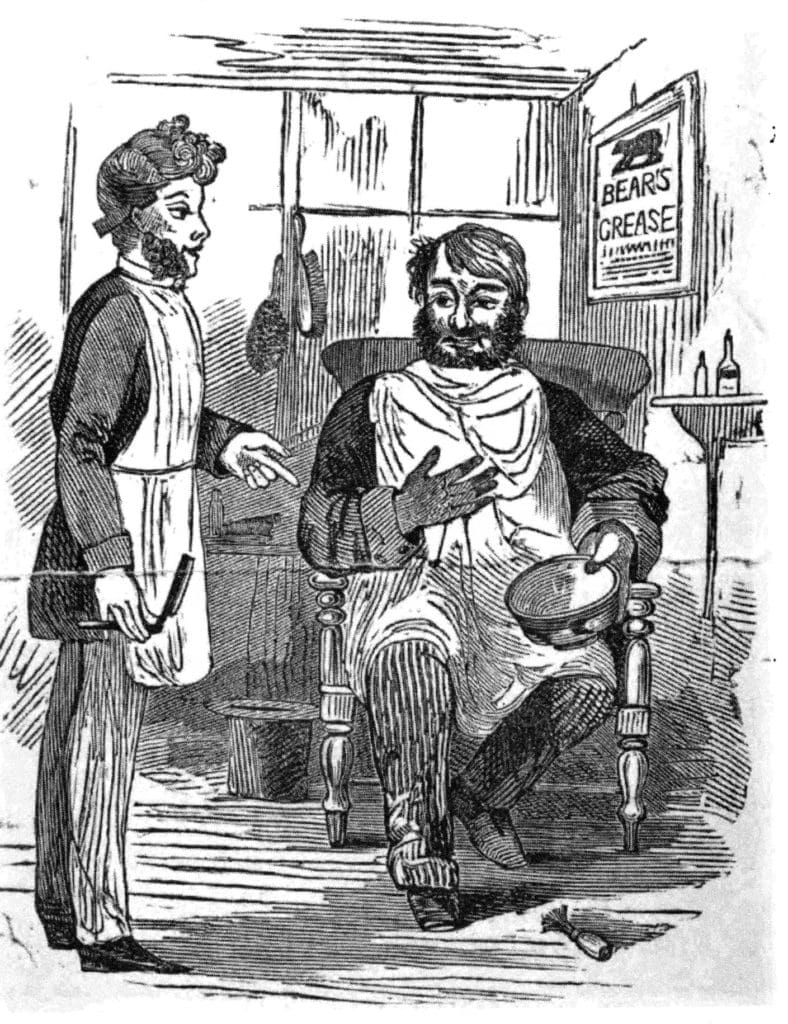
One such poem relates how Cousin Jack went up to London, which possibly echoes the London setting of Forfar’s earlier Cousin Jan story. Whilst there, he spies a barber’s shop: ‘There’s nething down to Camebourne like this here’ he declares, and goes in for a shave. Once inside, the ravenous Cousin Jack mistakenly takes a bowl of soap and suds for broth with potatoes in and greedily consumes it. The barber, astonished to find that his soap and suds had vanished, asks Cousin Jack what had happened:
“Now thee shust naw my dear, I didn’t ait
“Last night “said cousin Jack.” A croom ov mait,
“And so I clinch’d the bason jist like that –
“And lapp’d it in a moment like a cat;
“Theest see no more ov it to day,
“I skat the shaving brish away
“I dedden mind for spoons, or sives, or bread,
“I liked your brath oncommon well I ded;
“There, I can’t tell tha how;
“I tried and tried to chow;
“Twa’s like this here,
“I cudden bear the tetties, no my dear’’[27]
It is of interest here to draw attention to the article entitled ‘West Cornwall Words’ by Margaret Ann Courtney which accompanied those that were authored by Thomas Quiller Couch in 1880. She states that in the western mining districts, a ‘Cousin Jacky’ meant ‘a foolish person, a coward’, whereas ‘Cousin Jan’ referred to a miner.[28] Note that a well-known early-nineteenth century Gwennap bal-maiden’s (female surface ore-dresser) chant includes a reference to the ‘old Jan’, meaning the ‘surface captain’:
‘I can buddy and I can rocky,
And I can walk like a man,
I can looby and shaky,
And please the old Jan’.[29]
Undoubtedly the gullible ‘Cousin Jack’ of the dialect stories, which arguably arose out of the internal movements of miners from West Cornwall eastwards through the Duchy, fed on the intense parochialism of community rivalries, as hinted at by Couch. Note that Forfar, who is from Breage in the west describes the exploits of a ‘wise fool’ named ‘Cousin Jan’, whereas Daniel, from Lostwithiel in the east, describes the exploits of an ‘unworldly fool’ called Cousin Jacky. This is probably no coincidence.
So, there are numerous literary references to a gullible and amusing Cousin Jack(y) in Cornwall, but what about overseas? The earliest references to Cousin Jack so far uncovered are from a South Australian newspaper in the spring of 1848 in relation to a court case. The evidence from one of the men involved in this included the statement, ‘I don’t like you Cousin Jackies, keep your own company, and I’ll keep mine’.[30] Undoubtedly, the term had found its way there following the explosion of mining immigration on foot of the beginning of commercial copper mining at Kapunda and then Burra in 1844-5. It crops up again in South Australia in 1854, when a man named John O’Connell, who is most probably Irish, said to a Cornish miner ‘You’re a b——, Cousin Jacky, ain’t you?’.[31] This appears to highlight a process of ethnic ‘othering’ which underlay simmering tensions with miners from other regions. This found greater expression in neighbouring Victoria where gold was discovered in 1851, prompting an almighty gold rush.
Newspaper reports begin to crop up about conflicts between the Cornish and miners from other parts of the British Isles. In 1855, extracts from a private letter penned in the autumn of 1854 by an Englishman in Ballarat describing life in the ‘diggings’, was published in a Liverpool newspaper. It mentioned a number of skirmishes over placer claims between Cousin Jacky and ‘lazy’ Irish miners.[32] At a riot in the Ballarat gold diggings in 1857 it was noted, ‘There were “Tips” and “Geordies” and “Cousin Jacks” altogether…’ and during the 1861 Catherine Reef Turnout (strike) it was said to have been ‘… notorious that “Geordie” and “Cousin Jack” have no love lost between them.’[33] The Cornish and the Welsh were said not to get along either, while a report of a fight between the Irish and Cornish in Daylesford one Sabbath in 1862 noted:
‘If Cousin Jacks and Paddies cannot live amicably together like good colonists, as they should do, let them at once elect some other day than Sunday for referring their dispute to the discreditable arbitrament of a faction fight, which never yet settled anything.’[34]
Interestingly, by the late-1850s, the Cornish in Victoria are referring to themselves as ‘Cousin Jack’, as seen in a Beechworth wrestling advert of 1857,[35] and, as accomplished hard rock miners, rather than unskilled or semi-skilled placer miners, they are winning plaudits for their mining know-how on the wet and difficult gold reefs of Victoria:
‘The Cornishmen, from their familiarity with mining operations at home, possess greater advantages than others in searching for gold in such places as present more than ordinary obstacles to the pursuit. As a class, they are equal to any in the point of persevering enterprise, and form a most valuable addition to the industrial element in our population. Whether in the wettest and deepest sinking, or the hardest and longest tunnelling, you may be certain to find “Cousin Jack” among the foremost.’[36]
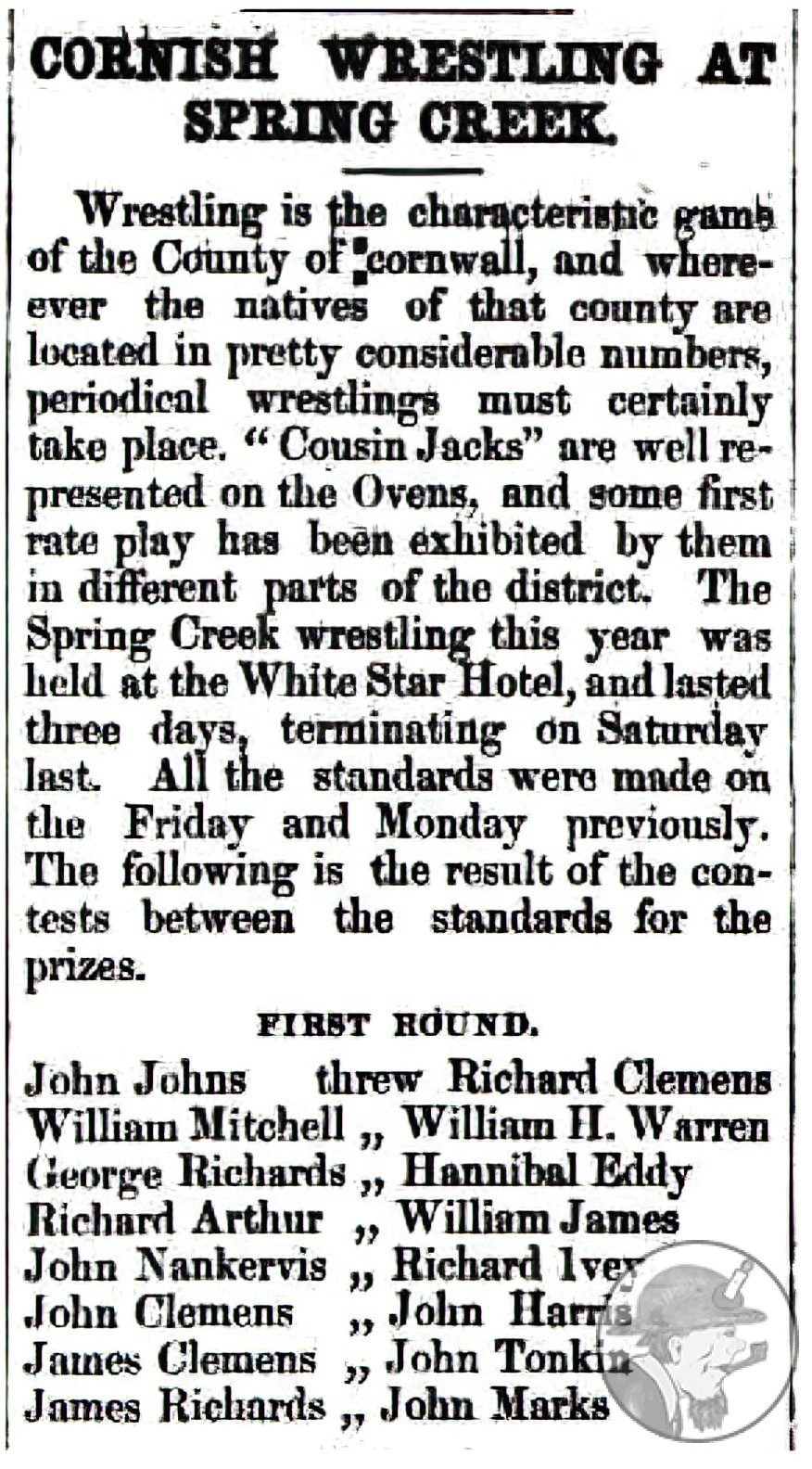
But the references to Cousin Jack in the Victorian goldfields bear no hint of humour, and no mention to a quaint or amusing dialect. Quite the contrary – the tone is serious. By the late-1850s, the descriptions of ‘Cousin Jack’ in Australia seem to be coalescing around distinctive cultural activities such as Cornish wrestling, ethnic ‘otherness,’ and mining prowess.
By the 1860s, the ‘Cousin Jack’ nickname had taken hold in English mining areas too. Across the Tamar in Ashburton in 1861 a man refers to ‘Cousin Jacks’ as being miners,[37] and in 1864, a court in Ulverstone heard of an altercation that occurred at Stone Cross near Pennington between a local man and a Cornish miner, whereby a woman was assaulted. The injured woman’s son in giving evidence noted that “Cousin Jacks” was the term applied to all Cornishmen.[38] And in 1866, a Tavistock newspaper covering a story about the ill-feeling caused by the migration of Cornish miners to northern collieries following the closure of scores of mines in Cornwall stated: ‘These delegates from the north must think that Cousin Jacks are fools to remain at home and starve when there is labour to be had elsewhere.’[39]
We then see the nickname cropping up with increasing regularity worldwide, epitomised by the Rev. E.E. Chambers, son of the Vicar of Cury near Helston, who encountered Cornish miners in the West Coast gold fields of New Zealand’s southern island in the late-1870s. Here they made up about a quarter of the gold mining population and he states: ‘… from no class have I received greater kindness than from the Cornish miner… the hearty laugh of my Cornish host has carried my thoughts to our “Cousin Jacks” across the sea’.[40] A letter to the Cornishman in 1884 amusingly describes ‘Cousin Jackey’ adapting to life in a gold mining camp in Akankoo, West Africa, while in 1889, a return miner from Liskeard notes how Cousin Jack was well to the fore in the Transvaal gold mines.[41] Indeed, it was not long after the founding of the gold rush city of Johannesburg, that a favourite Cornish meeting place dubbed ‘Cousin Jack’s Corner’ sprang up in the centre of the developing metropolis.[42]
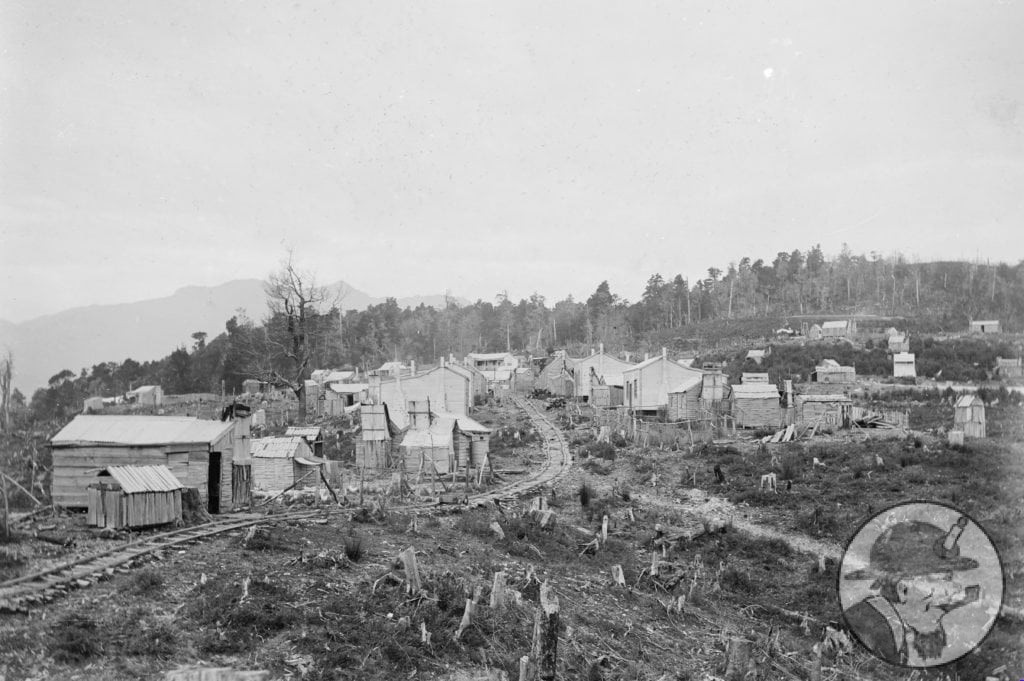
However, by the 1880s, we see a subtle change in the Cousin Jack identity. As well as lauding his mining prowess, mention is once more made to his dialect, as illustrated by a paper presented in Michigan in 1887 by John H. Forster, who opined that his language attracts the most attention: ‘his dialect, pure and simple, is unique.’[43] This change has arguably arisen due to the popularity of humorous publications doing the rounds in Cornwall and other parts of Britain, where Cousin Jack is portrayed in a tongue-in-cheek manner as an endearing figure of jest, the humour value of which is heightened by his unique dialect and quick wit.[44]
Indeed, newspaper editor, Herbert Thomas, who arguably become the Rupert Murdoch of Cornwall, such was his hold on the Cornish press in the decade either side of 1900, played no small part in this. He published many humorous Cornish dialect stories, for example ‘The Tolscadlum Club Lectures’ which appeared in the Cornishman in 1892, and often quoted the dialect of everyday conversation in his news reports. As the Cornish mining industry faltered in the closing decades of the 1800s, this vision of Cousin Jack made its way overseas, even to the remotest mining camps, largely through the pages of Thomas’ newspapers, the Cornishman and the Cornish Post and Mining News. In these papers he deliberately republished snippets of information of relevance to Cornish mining from foreign newspapers, and included a ‘News From’ section, by cultivating correspondence with Cornish people in mining settlements worldwide. Hence, he created a narrative of a transnational world, a Cornish diaspora dominated by ‘Cousin Jack’ with Cornwall at its heart. Cousin Jack was thus fused with the idea of a miner from a distinct region and ethnic group, who was a hard rock miner par excellence.
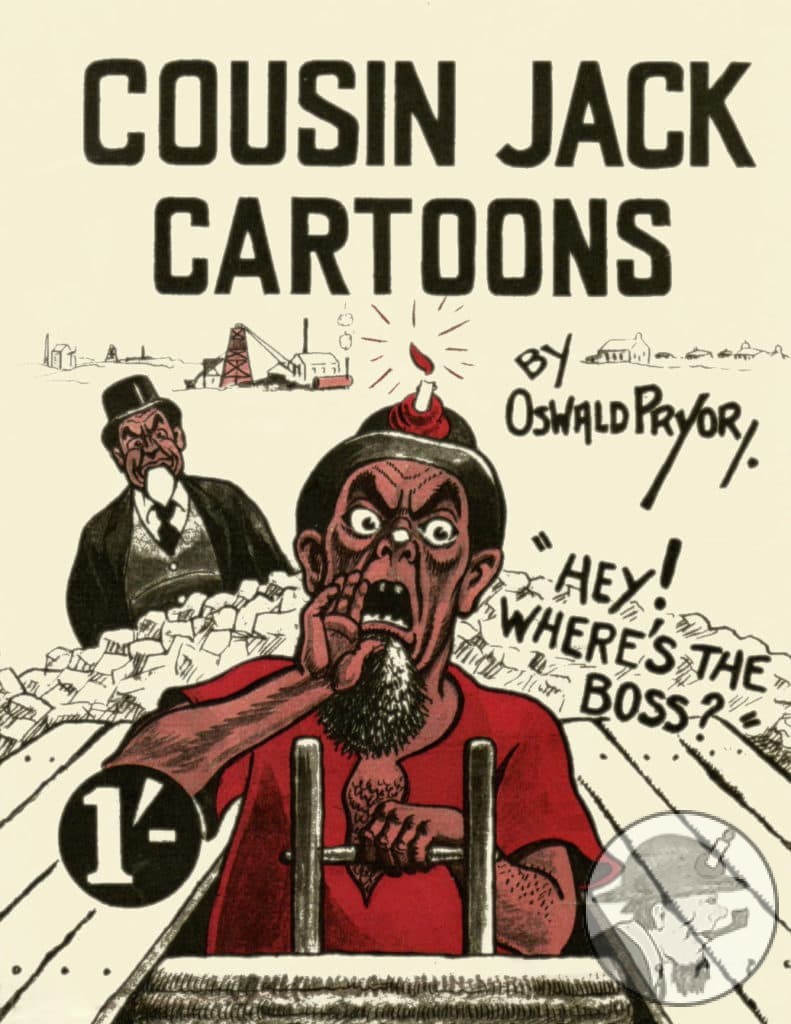
This image of Cousin Jack the Cornish miner is epitomised by Oswald Pryor (1881-1971), Cornish-bred at the copper mining town of Moonta in South Australia. Pryor drew on his Cornish heritage to great effect, penning a series of highly popular satirical cartoons based on intimate observations of the speech and traditions of the Cornish families at Moonta and Wallaroo, the miners, their ‘cappens,’ preachers, and chapels.[45] His first cartoon was published in 1901, and later many appeared in the Bulletin, the South Australian Wireless Monthly and other periodicals. In 1950 he privately published a collection of his cartoons as Cornish Pasty.[46] A classic example of this humour is a cartoon containing the dialogue between a tribute pare (a group of miners) and the Mine Captain:
“Only one-and-six tribute, Cap’n? Why that edden nuthin
Better taken un, boays, nuthin’s better than nuthin’ ‘t all.”[47]
Why Cousin and Why Jack?
We have traced the spread of the nickname Cousin Jack within Cornwall and beyond, but this does not explain why Cousin, and why Jack. Herbert Thomas dismissed the Californian ‘Cussin Jack’ hypothesis, arguing that Cousin Jack(y) arose due to the fact that the Cornish were actually closely related to each other, and their bonds of kinship were real and therefore expressed in this manner.[48] He claims that the title ‘cousin’ was therefore common, and indeed, Margaret Courtney notes in her West Cornwall Words that ‘Cousin’ was a common epithet among Cornish gentlemen.[49] It might also be argued that ‘cozzen’ was used as a term of endearment amongst men who worked in a dangerous industry where bonds of kinship, real or otherwise, were important. Note the reference in a letter about the character of Cornish miners by Christopher Childs of Liskeard, published by the West Briton in 1864, which states: ‘… How forcibly does the familiar name “comrade”, and the expression of “Com’se along Cousin Jacky,” speak in favour of his friendly and social disposition.’[50]
However, Cornish miners didn’t use the term ‘cousin’ exclusively; they also referred to their work mates as ‘pardner,’ (shortened to pard) or ‘comrade’ (as highlighted by Childs’s statement above), so these hypotheses, whilst interesting, are not wholly convincing. As for Jack part – Jack is of course the diminutive of John which was a very common name in Cornwall, and up until 1830 was the most popular name in England and Wales, after which it slipped to second. Given its widespread popularity, ‘Jack’ was commonly used to represent an everyman, as in the phrase ‘Jack of all trades.’ But perhaps there is a less prosaic explanation.
Long before the dialect poems of Forfar and Daniel, the droll-stories of West Cornwall were popular. Many of these oral tales, told in a rambling narrative-style heavily peppered with words taken from the ancient Cornish language and embellished by the droll teller’s fancy, were collected and published in the 1870s by William Bottrell (1816-1881). He was a native of the West Penwith peninsula and would have heard many of them in his youth.[51] Indeed, Bottrell was chiefly responsible for the preservation of Cornish folklore, and contributed over fifty stories to Robert Hunt for his 1865 two-volume, Popular Romances of the West of England.[52]
While the stories are woven around the folk of West Cornwall, there are many references to supernatural and fantastical creatures, including giants. One of the stories entitled Legends of the West-Country Giants concerns a giant named Jack. [53] He is a ‘tinkard’ (tinner) who travels to the hills of Towednack in West Penwith from a moorland area far to the east, which sounds suspiciously like Dartmoor, where he and others traded tin with merchants from a nearby city (Exeter?). At Towednack, Jack encounters a rather dumb, brutish giant named Tom. He was a farmer who had a daughter named Genever, the Cornish for Jenefer, the diminutive of which is ‘Jenny.’ Jack, who is smarter than the pugilistic and backward locals, teaches them how to recognise and seek out tin, and to appreciate its mercantile value. He soon became something of a folk hero:[54]
‘After the tinkard had settled in Morvah, he became known all about by the name of Jack of the Hammer, because he was said to have performed many wonderful feats with that tool, both in working and fighting, – such as making millstones, killing wolves, and smashing the skulls of sea-robbers who landed on the shores to steal the tin’.[55]
Interestingly, the local people refer to themselves as cousins, not in the meaning of being immediate blood relatives, but as a means of claiming a wider kinship. But most importantly, Jack marries Genever. As it notes in the story, ‘In Jack of the Hammer and Genevra, or An Jinnifer, as she came to be familiarly called, many of the ancient families of Morvah and the adjacent parishes had their rise.’[56]
Could this be the original source of ‘Cousin Jack,’ the Cornish miner, and his female equivalent, ‘Cousin Jenny,’ which has become the universal nickname for a migrant Cornishwoman? The earliest reference to Cousin Jenny discovered thus far occurs in 1868 at Peak Downs, a mining settlement in Queensland, Australia, when it was noted to be a term for a Cornish miner’s wife from Burra in South Australia, an area noted as being ‘mostly Cornish.’[57] This suggests that the term was in use in South Australia in the 1860s and possibly before. This is hardly a surprise, for as historian, Ian Auhl, has noted:
‘What happened in the old mining towns of Australia, at Kapunda, Burra, Moonta, Wallaroo and Kadina, is unique in Australia; that is, the transplanting of an indigenous Cornish mining architecture and of Cornish villages to the virgin lands of a new country. It was not only the architecture that was preserved, but a way of life.’[58]
Indeed, between 1846 and 1850, some 71 per cent of all Cornish migrants to the Australian colonies had gone to South Australia, and by 1865, Cornish settlers made up a staggering 42.5 per cent of South Australia’s immigrant population.[59] Crucially, in the mining towns of the colony of South Australia, there was a critical mass of indigenous Cornish to perpetuate the peculiarities of their cultural heritage, and even to create new Cornish-Australian ones. Hence, the mining towns and villages of South Australia are very likely to be the places where the Cousin Jack and Jenny nicknames were first in use outside of Cornwall.
It is worth noting that another droll story about the Giants of Trecobben and The Mount, relates that the giants crafted a ‘cobbling-hammer’ which they threw back and forth to each other.[60] Could this be the origin of the nickname of that hapless Redruth miner ‘Cousin Jack Cobbler’, or the name of a gold placer the Cornish were working in Victoria in 1858 called ‘Cobbler’s Gully’?[61] If so, it certainly suggests that the droll stories of West Cornwall had migrated to Australia in the first half of the nineteenth century.
More importantly, the ancient droll story about ‘Jack of the Hammer’ could be one of the sources of a hugely popular adventure story known variously as Jack and the Giants or Jack the Giant Killer. No text of Jack the Giant Killer has been found which establishes that the tale was in circulation before the eighteenth century. It is alleged to have first been published in two parts in 1711 by J. White of Newcastle under the title, The History of Jack and the Giants, and underwent numerous incarnations in print thereafter.[62]
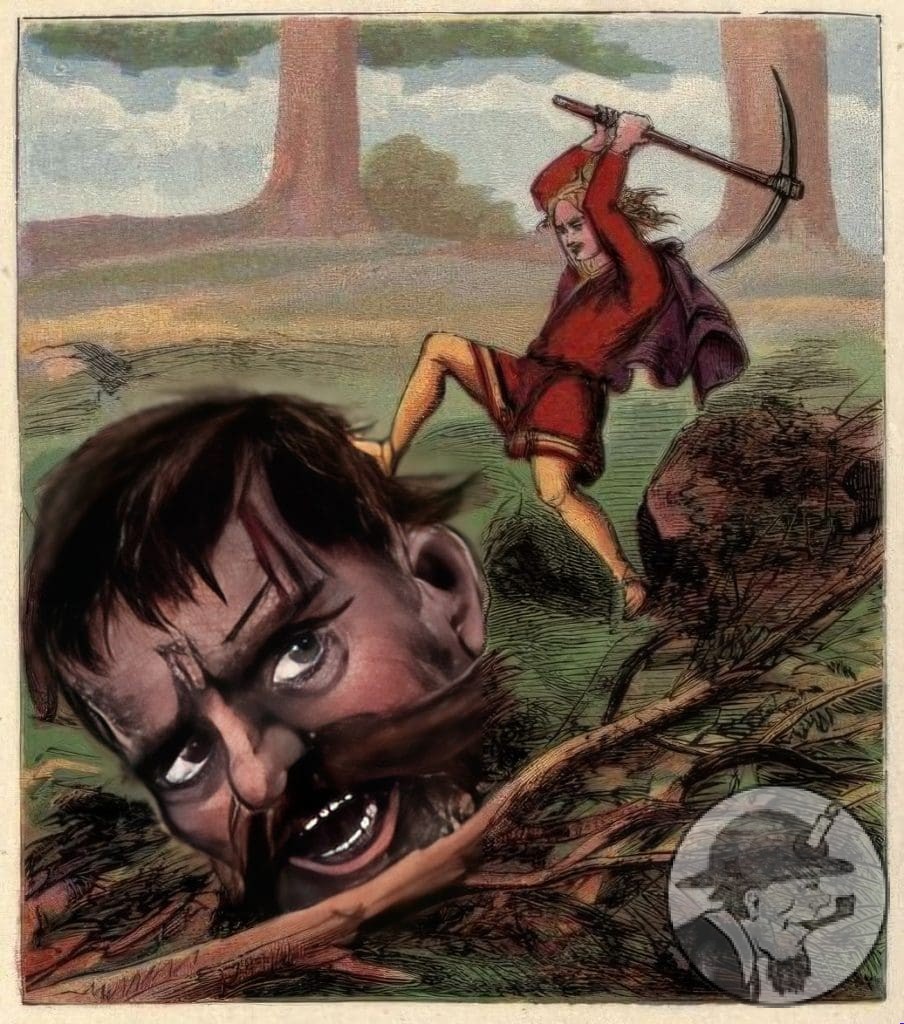
The source of Jack the Giant Killer is notoriously difficult to pin down, and the story had probably existed as a number of separate episodes for some centuries in England, even if it was only united into one coherent narrative at the beginning of the eighteenth century. Peter and Iona Opie argue that the ascription of Jack’s relationship to Cornwall might suggest a Brythonic origin, and that it probably originated in the oral traditions of the Cornish (and/or Breton) ‘droll teller,’[63] although it must also be acknowledged that this and other popular stories could well have influenced the drolls of West Penwith. Indeed, there is some debate about whether the figure of Jack even has a Cornish provenance.[64] However, before mass literacy from the mid-nineteenth century onwards, the majority of working-class people in Cornwall would only have been aware of the Jack and the giant stories through oral means. In other words, through the droll tradition.
The central plot of the story is that Jack rid Penwith of a giant named Cormilan/Cormoran who lived in a cave at St Michael’s Mount and raided the local countryside for livestock at will. Jack tricked him by digging and disguising a hole. He then roused the giant, trapped him in the hole and finished him off by driving a pick axe into his skull. For this great feat he was rewarded with the giant’s treasure and named “the Giant Killer,” by the worthies of Marazion, a title that carried with it a sword and an embroidered belt, which read:
Here’s the right valiant Cornish Man,
Who slew the Giant Cormilan.[65]
Our hero then migrates to Wales where further encounters with giants await. In one important incident, he pounds on the door of a giant’s castle and announces that he was his ‘Cousin Jack’ who had come to warn him that a number of men in armour were approaching his castle intending to kill him. Jack cunningly tricks this giant into hiding in his own dungeon while he feasts in his hall.
Whether or not the droll stories of West Penwith influenced the Jack the Giant Killer story or vice versa is not really important. What is important, is that this highly popular story contains a number of interesting facts that arguably throw light on the etymology of the nickname of the Cornish miner, ‘Cousin Jack’. It has a man named Jack as its central character, a heroic figure who grew up in West Cornwall and achieved fame through his ability to dig large holes; he wielded a miner’s tool, namely a pick axe; he migrated to Wales; and whilst there he referred to himself as ‘Cousin Jack.’
Conclusion
As internal migration within Cornwall gathered pace in the early- to mid-1800s, the pejorative connotation stoked by parochial rivalries that was attached to ‘Cousin Jack’ in East Cornwall took hold, and this image was later overlaid by the gullible fool image of dialect literature. But an alternative and competing identity appeared to have been that of the popular and heroic figure of Jack who took on giants, the origin of which arguably lay in the droll stories of West Penwith, which were carried eastwards by internal migration, and which later fused with the gullible fool character of the dialect literature. Thus, men from Cornwall, especially those who wielded hammers or picks or worked down holes, were dubbed ‘Cousin Jacks’, a nickname that was self-deprecating and tongue-in-cheek, and primarily intended for a Cornish audience. But the nickname soon spread with the onset of mass literacy.
The nickname almost certainly travelled with the Cornish who took ship for Australia before dialect stories became fashionable. It was in use in the copper mining areas of South Australia in the late-1840s, a colony that became the epicentre of Cornish identity ‘Down Under’. By the 1850s it was being used by the Cornish themselves in the neighbouring goldfields of Victoria, but without any pejorative connotations. For in the ethnic melting pot of Australia, the Cornishman ‘Cousin Jack’ became conflated with mining prowess. Doubtless any Cornishman working there, whether he hailed from the western or the eastern half of the Duchy, would object to being dubbed a ‘Cousin Jack,’ who was now viewed, and envied, as a member of an exclusive ethno-occupational club, which ensured his dominance in the multi-ethnic mining labour market.
Our male migrant needed a female equivalent, so Cousin Jenny was co-opted at a later date, quite possibly from a droll-story, and this undoubtedly occurred in South Australia. Finally, the Cousin Jack identity undergoes a further metamorphosis overseas by the 1880s, as a unique, quick-witted humour and a quirky dialect were grafted onto that of ethno-occupational prowess. Thus, emerged the Cousin Jack figure which is exemplified in Oswald Pryor’s satirical cartoons – the figure with which we are familiar today.
This working paper was first presented online in March 2021 as part of the Kresen Kernow series of lectures ‘Cornwall: At Home and Away’. I acknowledge the input of Dr Caitlin Green, with whom I have enjoyed several interesting exchanges.
References
[1] Pryor, Oswald (1962, republished 1973) Australia’s Little Cornwall, Adelaide, 13.
[2]Schwartz, Sharron P. (2002) ‘Exporting the Industrial Revolution: The Migration of Cornish Mining Technology to Latin America in the Early 19th Century’, in Heidi Slettedahl Macpherson, and Will Kaufman, (eds) New Perspectives in Transatlantic Studies, Lanham, 143-158.
[3] Schwartz, Sharron P. (2006) ‘Bridging “The Great Divide”: The Evolution and Impact of Cornish Translocalism in Britain and the USA’, Journal of American Ethnic History, 25:203, 169-189.
[4] Payton, Philip (1999) The Cornish Overseas, Fowey, 14.
[5] Deacon, Bernard and Schwartz, Sharron P. (2007) ‘Cornish identities and migration: a multi-scalar approach’, Global Networks: A Journal of Transnational Affairs 7:3, 289-306, 293.
[6] Baines, Dudley (1985) Migration in a mature economy: emigration and internal migration in England and Wales 1861-1900, Cambridge, 158-9.
[7] James, Ronald M. (1994) ‘Defining the Group: Nineteenth Century Cornish on the North American Mining Frontier’ in Philip Payton (ed), Cornish Studies 2, 32-47, 40.
[8] Burke, Gillian (1984) ‘The Cornish Diaspora of the Nineteenth Century’, International Labour Migration: Historical Perspectives. Shula Marks and Peter Richardson (eds) London, 57-75.
[9] Rowe, John (1974) The Hard-Rock Men: Cornish Immigrants and the North American Mining Frontier, Liverpool University Press, Preface vi.
[10] Edinburgh Evening News, ‘The “Boom” in Tin’ 19 May 1906, 8.
[11] Hand, Weyland D. (1946) ‘The Folklore, Customs and Traditions of the Butte Miner (Concluded)’ California Folklore Quarterly, 5:2, 153-58, 174.
[12] Schwartz, Sharron P. (2016) The Cornish in Latin America: ‘Cousin Jack’ and the New World, Wicklow, 140. ‘One and All’ is the Cornish motto.
[13] The Cornishman, ‘Cousin Jack’, 23 January 1947, 4.
[14] Schwartz, Sharron P. (1999) ‘Creating the Cult of “Cousin Jack”: Cornish Miners in Latin America 1812-1848 and the Development of an International Mining Labour Market’, unpublished paper, University of Exeter; Payton, Overseas, 14-42.
[15] Evening Star, ‘Mining Managers’ Association Social’, 8 March 1901.
[16] Cornubian and Redruth Times, ‘“Cousin Jack” and “Cussing Jack”’, 4 June 1908, 3.
[17] The Cornishman, ‘“One and All Notes”’, 17 September 1903, 4.
[18] The Cornish Telegraph, ‘Coroner’s Inquest’, 27 September 1854. A much later article further notes that his body was ‘drawn to grass Friday 10th Sept. and buried the following Sunday afternoon when thousands of people attended the funeral,’ Cornubian and Redruth Times, 24 March 1899.
[19] Couch, Thomas Quiller (1880) ‘East Cornwall Words’, A Glossary of Words in Use Cornwall, English Dialect Society, London, 70–1.
[20] Joyce, Patrick (1991) Visions of the People: Industrial England and the Question of Class, Cambridge, 279-301.
[21] See Deacon, Bernard (2001) ‘The reformulation of territorial identity: Cornwall in the late eighteenth and nineteenth centuries’, Unpublished PhD thesis, Open University, 93-103.
[22] Sandys, William (1846) Specimens of Cornish Provincial Dialect, Collected and Arranged by Uncle Jan Treenoodle, With Some Introductory Remarks, And a Glossary, By an Antiquarian Friend, Also a Selection of Songs and Other Pieces Connected with Cornwall, London.
[23] Kent, Alan (2000) The Literature of Cornwall: Continuity Identity Difference 1000-2000, Bristol, 120.
[24] Tregellas, John T. (c1863) Cornish tales: in prose and verse, with a glossary, Truro.
[25] Forfar, William B. (1850) ‘Cousin Jan’s Story’ The Bâl, or ‘Tes a Bra’ Keenly Lode: A Descriptive Cornish Ballad, Helston.
[26] Daniel, Henry J. (n/d) ‘Cousin Jack and the London Barber’, The Cornish Thalia; Being Original Comic Poems, Illustrative of the Cornish Dialect, Devonport and London, 19-21. This story first appeared in a collection of stories published in 1859 in Truro entitled Cornish Tales in Verse and Prose, Being Specimens of Cornish Provincial Dialect.
[27] Daniel, (n/d) ‘Cousin Jack and the London Barber’, 21.
[28] Courtney, Margaret A. (1880) ‘West Cornwall Words’, A Glossary of Words in Use Cornwall, English Dialect Society, London, 14-15.
[29] Schwartz, Sharron P. (2000) ‘No Place for a Woman: Gender at Work in Cornwall’s Metalliferous Mining Industry’, Cornish Studies 7, Philip Payton (ed), 94.
[30] South Australian Register, ‘Coroner’s inquest, manslaughter’, 30 May 1848.
[31] South Australian Register, 2 June 1854.
[32] The Liverpool Mail, ‘Australia’, 27 January 1855, 5.
[33] The Star, ‘Court of General Sessions for the District of Buninyong and Ballarat’, 19 March 1857, 2; Bendigo Advertiser, ‘Catherine Reef Turnout’, 19 August 1861.
[34] The Argus, ‘The Goldfields’, 27 August 1862, 5; The Star, ‘Sanctifying the Sunday’, 8 August 1862, 3.
[35] Ovens and Murray Advertiser, 29 December 1857, 3.
[36] Mount Alexander Mail, ‘Fryer’s Creek’, 20 August 1858, 4.
[37] The Western Times, ‘The Alleged Murder at Torrington’, 16 March 1861, 3.
[38] Ulverston Mirror and Furness Reflector, ‘Assault Upon a Woman’, 21 May 1864.
[39] Tavistock Gazette, ‘Down the Pit’, 30 November 1866.
[40] Cornish and Devon Post, ‘Cornish Miners in New Zealand’, 3 January 1880.
[41] The Cornishman, ‘Cousin Jackey on the West Coast of Africa’ 10 April 1884, 7; West Briton and Cornwall Advertiser, ‘Johannesburg, A Little Information’, 28 November 1889, 6.
[42] The Cornishman, ‘Early Days of Kimberley and the Rand’, 16 January 1924, 7.
[43] John H. Forster (1888) ‘Life in the copper mines of Lake Superior’, Michigan Pioneer and Historical Collections, 9, 183–4.
[44] See Kent, Alan (2004) ‘Drill Cores’: A Newly-Found Manuscript of Cousin Jack Narratives from the Upper Peninsula of Michigan, USA, in Cornish Studies 12, Philip Payton (ed), 106-143, 120.
[45] See Payton, Philip (2007) Making Moonta: The Invention of Australia’s Little Cornwall, Exeter, 1.
[46] Pryor, Oswald (1961) Cornish Pasty: A Selection of Cartoons, Adelaide.
[47] Pryor, Oswald, (1976 reprint) Cornish Pasty: A Selection of Cartoons, Adelaide, 28.
[48] The Cornishman, ‘“One and All Notes”’, 17 September 1903, 4.
[49] Courtney (1880) ‘West Cornwall Words’, 14-15.
[50] West Briton and Cornwall Advertiser, ‘The social and moral improvement of the working miners of Cornwall and Devon’, 28 March 1862, 8.
[51] Bottrell, William (1870) Traditions and Hearthside Stories of West Cornwall: By William Bottrell (An Old Celt), Penzance (republished in 1970 as Hearthside Stories of West Cornwall) Newcastle upon Tyne.
[52] Hunt, Robert (1864) Popular Romances of the West of England: The drolls, traditions, and superstitions of old Cornwall.
[53] Bottrell (1970), Hearthside Stories, 9-49.
[54] For a discussion of the symbolism of this, see Manning, Paul (2005) ‘Jewish Ghosts, Knackers, Tommyknockers, and Other Sprites of Capitalism in the Cornish Mines’ in Philip Payton (ed), Cornish Studies 13, 216-255.
[55] Bottrell (1970), Hearthside Stories, 44.
[56] Bottrell (1970), Hearthside Stories, 45.
[57] Brisbane Courier, ‘Copperfield’, 25 July 1868, 5.
[58] Auhl, Ian (1969), Burra Sketchbook, Adelaide, 63.
[59] Payton (1999), The Cornish Overseas, 256-8.
[60] Bottrell (1970), Hearthside Stories, ‘Carn Galva, and the Giant of the Carn’, 47-49.
[61] Mount Alexander Mail, ‘Fryer’s Creek’, 20 August 1858, 4.
[62] For a discussion of this story see Opie, Peter and Opie, Iona (1974) The Classic Fairy Tales, Oxford, 47-8. I acknowledge the conversations about the etymology of Cousin Jack that I have had with Dr Caitlin Green. See her article here: https://www.caitlingreen.org/2021/01/cousin-jack-origins.html
[63] Opie and Opie, (1974) The Classic Fairy Tales.
[64] Green, Thomas (2007) ‘Tom Thumb and Jack the Giant-Killer: Two Arthurian Fairytales?’ Folklore 118:2, 123-140.
[65] Opie and Opie, The Classic Fairy Tales, 66. [/content_control]